

Caroline Scharf
Vice President of Operations
Digital twins promise real-time awareness, predictive insight, and closed-loop control, but none of these outcomes are possible without a continuous stream of accurate, well-structured, and timely data. In most enterprise environments, however, that stream is fragmented across incompatible systems, uneven update cycles, and integration layers that were never designed for real-time interaction. Before a twin can model behavior or support decisions, its data foundation must be engineered to eliminate gaps, delays, and inconsistencies that distort the system’s true state.
Why Digital Twin Data Integration Is the Cornerstone of Real-Time Operations
The Digital Twin’s Dependency on High-Quality, Low-Latency Data
Digital twins don’t process “data” in the abstract. They consume multi-format, asynchronous, and often contradictory signals from disparate systems. These include high-frequency sensor data (10ms refresh rates), batched ERP transactions, delayed event logs, and derived metrics from AI-based anomaly detection systems. Unifying such data in real time is a nontrivial challenge, requiring sophisticated buffering, transformation, and prioritization logic.
Latency, in this context, is not just network delay. It includes data ingestion lag, transformation pipeline latency, schema negotiation time, and decision latency, the delay between data arrival and system reaction. If a predictive twin for rotating machinery receives vibration metrics with a 5-second delay due to processing bottlenecks, its prediction window becomes useless.
Moreover, data quality is often compromised at the source. Sensor drift, communication noise, inconsistent time-stamping, and missing context (e.g., units, confidence intervals) require that data fusion logic include validation, correction, and, in some cases, estimation routines before the data enter the twin. A high-fidelity digital twin, therefore, is as much about data engineering as it is about modeling.
Modern IT/OT Stack Complexity: Why Integration Fails Without Design
The modern enterprise environment is not flat; it’s fragmented, layered, and often politically siloed. Operational systems (e.g., DCS, SCADA, PLCs) rarely speak the same language as IT systems (e.g., cloud APIs, enterprise service buses, data lakes). Integration failures typically occur at three levels:
- Semantic dissonance – Different systems represent the same entity differently: one might use AssetID, another MachineName, and a third just a MAC address. Aligning these requires ontology mapping and master data harmonization.
- Temporal mismatch – OT systems emit events continuously or cyclically at 100Hz; ERP systems generate state changes every few hours. Integrating them naïvely results in misaligned event windows and causality gaps.
- Interface fragility – Many integrations depend on custom adapters, fragile REST endpoints, or deprecated middleware. These become brittle during system updates, disrupting data flow and undermining trust in the twins’ fidelity.
Designing a robust integration strategy demands clear interface contracts, publish/subscribe decoupling, canonical data models, and resilient orchestration logic. Without this, integration is an accidental artifact, not an engineered capability.
Enterprise Systems That Require Digital Twin Data Integration
ERP: Operational Alignment and Financial Coherence
Enterprise Resource Planning systems encompass operational commitments, including production orders, inventory positions, maintenance schedules, and financial events. While ERP systems typically operate at lower temporal resolution, their semantic richness is critical to closing the loop between physical events and business outcomes.
For a digital twin to influence, or even reflect, enterprise priorities, it must consume and respond to ERP state. For example, anomaly detection in a manufacturing twin may trigger not only an alert but also a work order in SAP, a labor reallocation, or a cost accounting update. This necessitates not just data access but also bidirectional, secure, transactionally aware integration.
The complexity lies in ERP's event model and API structure, which are not designed for high-frequency updates. Integration patterns here often require data virtualization, event abstraction, or state replication, along with strong authorization controls to prevent unintended propagation of simulation states back into production systems.
MES: Synchronizing Factory Floor Intelligence
Manufacturing Execution Systems are often the most data-rich and time-sensitive layer in the enterprise stack. MES systems track part flows, machine states, quality checkpoints, operator actions, and shift-level metrics, often in near-real time.
For digital twins deployed in production environments, MES integration is indispensable. It's what makes the twin current. Without MES synchronization, the twin either lags behind the physical system or operates on synthetic assumptions.
However, MES platforms are frequently customized, vendor-specific, and not designed for third-party consumption. Integrating with them requires either direct interface mapping or the use of intermediary data brokers to reconcile proprietary schemas, non-standard time bases, and event-capture inconsistencies. Robust time-series alignment, identifier resolution, and local buffering are mandatory to achieve deterministic behavior.
SCADA and Historian: High-Frequency Data for Live Feedback Loops
SCADA systems and historians represent the core telemetry infrastructure for industrial environments. They offer high-fidelity, timestamped data streams with millisecond to second resolution, which are essential for closed-loop control, predictive analytics, and system-state estimation within digital twins.
However, tapping into SCADA data is not straightforward. OPC UA and MQTT interfaces provide access but often operate under strict performance, security, and bandwidth constraints. Furthermore, historians frequently compress, aggregate, or delay data to improve storage efficiency, thereby compromising the required granularity.
Effective integration requires a strategy for stream duplication, non-intrusive read access, and edge-side preprocessing to reduce load on critical systems. In many deployments, decoupling production SCADA from digital twin telemetry via a data diode or staging layer is necessary to preserve operational integrity.
Architecture Models for Digital Twin Data Integration
Event-Driven Architecture (EDA) for Responsive Twins
Digital twins function as reactive systems. They monitor external change, assess internal state, and trigger responses, not in scheduled batches, but at the moment when deviation occurs. That behavioral model naturally aligns with event-driven architecture (EDA), where every relevant change is captured and propagated as an event.
Within EDA, digital twins subscribe to streams of state transitions, whether it’s a fault signal from a machine controller or a dynamic update in a process variable, and respond as needed. This architecture reduces latency, eliminates polling overhead, and allows the twin to maintain continuous situational awareness. Implementing EDA in this context means building on reliable brokers like Kafka or MQTT, enforcing schema contracts at the edge, and maintaining order and replayability under load. Without it, real-time becomes an illusion, and the twin reverts to periodic snapshots.
Integration via API Gateways, Middleware, and Pub/Sub Models
While event-based architectures underpin live synchronization, digital twins still require structured, deterministic access to enterprise data. Configuration metadata, asset registries, business rules, and operational constraints typically reside in systems that expose synchronous interfaces, often via APIs or legacy middleware.
Direct coupling to these interfaces introduces performance and availability risks. Mature integration approaches instead use API gateways to mediate access, abstract underlying implementations, and enforce contract-level controls. Event flow is preserved via pub/sub mechanisms that deliver high-frequency updates to the twin, while less dynamic elements are accessed via cached or periodic calls. This balance ensures the twin can be both reactive and structurally aware without relying on fragile point-to-point integrations.
Edge-to-Cloud Continuum: Where to Process and When
In industrial settings, data doesn’t reside in a single place, and processing it in the wrong place can lead to costs, delays, or outright failure. Some twin logic must run at the edge, close to physical systems, to handle noise reduction, temporal alignment, or immediate actuation. Other parts, such as complex analytics or historical correlation, demand centralized computing in the cloud.
Designing integration across this continuum involves more than routing. It requires understanding data gravity, latency tolerances, and domain ownership. Real-time telemetry may originate at the edge, but must be normalized and correlated upstream. The integration architecture must account for these flows and support partial synchronization, fallback mechanisms, and eventual consistency across distributed twin instances. Without explicit orchestration, this fragmentation undermines system integrity.
Digital Twin Integration Challenges in Large-Scale Environments
Inconsistent Data Models and Schema Mismatches
Digital twin implementations rarely begin with clean data. In large-scale environments, data originates from dozens of heterogeneous systems, each with its own schema, naming conventions, temporal resolution, and interpretation of context. One system may expose a flat asset hierarchy, another embeds rich metadata in deeply nested structures, while a third communicates via proprietary encodings with no shared identifiers.
The real challenge isn’t just ingesting this data, but reconciling meaning across models that were never designed to coexist or cooperate. When two systems refer to the same physical machine differently, or when one collapses operational states into single values while another expands them into process subtypes, semantic divergence breaks the twins’ internal coherence. Without schema governance, normalization rules, and a semantic contract layer, the twin becomes an unreliable abstraction that can’t safely drive decision support or automation.
Latency, Jitter, and Time Synchronization Issues
In distributed systems, time is not absolute. Real-time digital twins must ingest data from devices, controllers, APIs, and streaming platforms, each with its own notion of “now.” Network latency introduces delay, jitter causes variable arrival times, and clock skew across edge nodes distorts the temporal integrity of data streams.
The consequence isn’t just misalignment; it’s incorrect state interpretation. A command that appears to have occurred before its triggering condition may cause the twin to infer false causality. Without precise timestamping at the source, synchronized clocks (via NTP, PTP, or hardware time codes), and buffering logic to align out-of-order events, integration pipelines cannot maintain reliable sequencing. At scale, this undermines both analytics and real-time control.
Securing Data Across Zones and Vendors
Digital twin data rarely stays confined within a single security boundary. Enterprise-scale implementations integrate across production environments, corporate IT systems, third-party vendors, and cloud platforms. Each zone introduces its own trust model, access policy, and threat profile, and integration must traverse all of them.
Security in this context is not a network perimeter problem; it’s an end-to-end integrity challenge. Data must be protected in motion and at rest, with identity enforcement applied at every interface. Twin systems must authenticate event producers, verify message integrity, and ensure that no component can spoof, inject, or corrupt the system state. Vendor platforms often introduce additional complexity through opaque telemetry layers or non-standard identity schemes, which require proxy isolation or controlled ingestion gateways. Without a unified, zero-trust-aware integration layer, the twin becomes a propagation surface for systemic risk.
Integrating Legacy Systems Without Breaking Operations
Legacy systems are unavoidable in real-world operations, and often indispensable. Yet these systems were not built for composability, openness, or real-time interaction. Many lack standardized interfaces, expose no event model, or are deeply embedded within deterministic control loops that cannot tolerate external load.
Digital twin integration in such contexts must proceed without destabilizing production. This requires architectural decoupling: isolating legacy interactions behind protocol converters, buffering middleware, or synthetic event generators. Even then, behavior must be validated, not just for connectivity, but for deterministic consistency. Introducing a polling adapter into a real-time loop, for example, can subtly shift timing guarantees and break closed-loop control.
The integration must account for operational invariants, latency ceilings, fault domains, and safety constraints, and fully respect them. When done carelessly, legacy integration introduces silent degradation: systems continue to function, but the twin receives an incomplete or misleading state, eroding its value without immediate detection.
Best Practices for Scalable Digital Twin Data Integration
Use Canonical Models to Abstract System Complexity
In complex integration environments, data does not merely differ in structure; it differs in worldview. Enterprise systems, operational platforms, and control layers each define assets, relationships, and states according to their own internal logic. Attempting to unify these via direct mapping results in brittle coupling and fragile data pipelines.
Canonical models offer a strategic alternative. Instead of forcing every source system to conform, a canonical model defines a neutral, semantically rich abstraction layer that each system can map to. This enables consistent representation of entities, machines, processes, and people, regardless of data origin. More importantly, it allows twin logic to operate against a stable semantic contract, even when underlying systems evolve. Without canonicalization, integration efforts scale linearly with the number of systems and fail when a node fails.
Decouple Twin Logic from Data Layer via Interface Abstraction
Digital twin logic, whether it models state transitions, behavioral patterns, or decision support, should never directly reference ingestion protocols, data schemas, or source formats. Yet many implementations bind twin execution to specific topics, REST endpoints, or database tables, creating tight operational dependencies that cannot scale or adapt.
Scalable architectures isolate twin logic through interface abstraction. This means introducing semantic gateways or data interface layers that expose normalized, versioned, and contract-governed data surfaces to the twin engine. The logic operates on meaning, not structure, and remains insulated from pipeline refactors, system migrations, or protocol shifts. This abstraction is not syntactic; it is ontological. It transforms the twin from a passive consumer of raw feeds into a governed agent operating against a validated context.
Ontological abstraction also aids reproducibility and scalability across multiple sites. In complex systems, digital twins may become so highly customized that little can be transferred to the next digital twin for a similar project. Ontological abstraction separates domain-aware intelligence from system-specific implementations, enabling each successive project to build on past success and generate more value.
Align Integration Cadence with Decision-Making Cycles
Not all real-time data is relevant in real time. A scalable integration strategy distinguishes between event frequency and decision cadence, aligning ingestion rate and processing granularity with the tempo of the required actions. If a control engineer acts once every five minutes, feeding 100 Hz sensor data into the visualization layer only increases cost, noise, and operational cognitive load.
This means defining priority tiers for data domains. Operational telemetry used for closed-loop control demands high-frequency streaming; supervisory data may require periodic deltas; enterprise signals (e.g., orders, shift schedules) operate in hourly or daily rhythms. Integration pipelines must honor this rhythm. Streaming everything at maximum resolution creates bottlenecks and desensitizes the system. Scalability depends on relevance-aware ingestion, not maximal throughput.
Validate Real-Time Feeds with Telemetry Health Monitoring
A common failure in digital twin systems is not that data stops, but that it silently degrades. A stream may drop a topic, shift structure, or stall due to misconfigured brokers or edge-side failures. The twin keeps running, unaware that it operates on stale, incomplete, or corrupted input.
Scalable twins treat telemetry itself as a monitored asset. Each feed should emit meta-signals, heartbeats, payload-size checks, schema hashes, and inter-arrival intervals, which are fed into a telemetry health-monitoring subsystem. This layer doesn’t track business logic; it tracks signal fidelity and operational confidence. Integration observability is not a luxury; it is a prerequisite. Without it, real-time becomes a matter of hope rather than a guarantee.
Leveraging Tom Sawyer Software Data Streams for Real-Time Integration Visibility
Digital twin systems rely on robust data pipelines that also provide visibility over the processes that ensure data integrity. Tom Sawyer Data Streams provides this capability by delivering real-time, graph-based visibility into the integration fabric that powers the twin.
Instead of showing a fixed topology, Data Streams renders a live operational graph that updates as telemetry arrives, schemas evolve, and ingestion pipelines adjust their behavior. This allows teams to immediately see how assets, services, gateways, and transformations interact across the architecture.
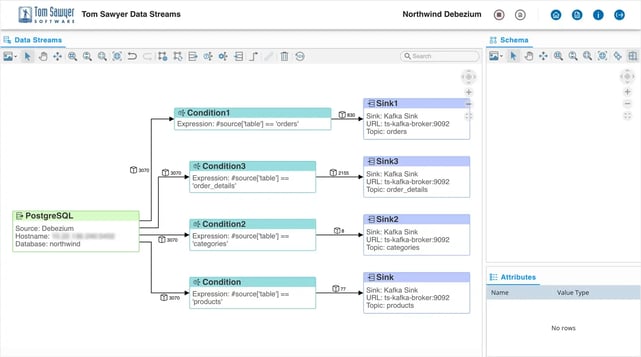
Tom Sawyer Data Streams illustrates how data is collected and transformed.
The visualization layer becomes an active diagnostic tool rather than just an interface. It helps engineering and operations teams detect integration drift early, validate data flow integrity, and ensure the digital twin operates on current, consistent, and trustworthy information.
In large-scale environments, this level of real-time insight is essential. Tom Sawyer Data Streams provides the observability needed to keep integration reliable and aligned with real-world conditions, ensuring the twin maintains accurate situational awareness.
Industry Use Cases of Digital Twin Data Integration
Utilities: Grid-Level Load Balancing with Live IoT Twin Streams
In modern utilities, the shift toward distributed energy resources (DERs) has fragmented load dynamics. Traditional SCADA systems, while reliable, lack the temporal resolution and spatial granularity required to manage decentralized grids. Integrating digital twins at the grid level enables near real-time visibility into load behavior, generation variability, and fault propagation.
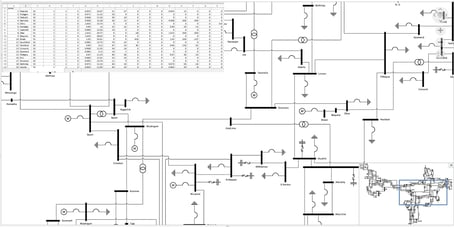
Visualization of a complex electrical grid.
Twin instances ingest high-frequency IoT telemetry from substations, smart meters, and edge controllers. These streams are normalized against a canonical grid topology, enabling the twin to simulate state transitions under various load conditions. Integration complexity lies in resolving inconsistent metadata, aligning asynchronous event streams, and maintaining latency below the thresholds needed for balancing decisions. The twin does not replace control systems; it augments them with predictive context, derived from integration-aware modeling of distributed physical assets.
Transportation: Predictive Maintenance via Edge-Twin Architecture
Fleet management in rail, aviation, and heavy road transport involves mobile, heterogeneous assets that are often disconnected from central systems. Digital twins deployed at the edge, embedded within vehicles or depots, collect telemetry from onboard systems: engine diagnostics, brake pressure patterns, vibration signatures, and environmental conditions.
Edge-resident twins perform local anomaly detection and emit event summaries to centralized platforms only when thresholds or patterns are violated. Data integration here involves reconciling event schemas across platforms (onboard units, depot servers, ERP maintenance modules), and maintaining identity coherence across transient network environments.
This architecture reduces bandwidth demands, preserves operational autonomy at the edge, and enables just-in-time maintenance, in which twin-derived insights, rather than calendar triggers, drive service intervals.
Aerospace: Real-Time Flight Twin Coordination Across Systems
In aerospace, the digital twin spans aircraft, ground infrastructure, ATC coordination, and mission planning systems. Data integration here is defined not only by technical heterogeneity but also by strict real-time and safety constraints.
During flight, twin instances ingest telemetry from avionics systems, propulsion modules, and environmental sensors, streamed over secure airborne networks. These are fused with pre-flight configuration data and maintenance histories to generate a complete situational model. Ground-based systems mirror this twin state, enabling synchronized coordination between onboard logic and flight operations control.
Challenges in integration include schema drift across vendors, latency guarantees, and state synchronization under intermittent connectivity. Integration success is measured by operational continuity: deviations detected by the twin must be resolved into actions before they impact flight safety or mission outcomes.
Manufacturing: Adaptive Assembly Lines Informed by Twin Analytics
In high-throughput manufacturing, digital twins sit at the intersection of control systems (PLC, SCADA), planning systems (MES, ERP), and quality assurance platforms. Integration must bridge cycle-level shop-floor telemetry with batch-level planning data and long-term statistical process control.
Digital twins aggregate real-time signals from sensors, robot controllers, and machine vision systems. These are integrated with product configuration data and operator logs to build a live model of process capability. When deviations emerge, temperature drift, cycle time creep, and tool wear, the twin identifies root causes and recommends parameter adjustments or preventive actions.
Integration architecture must accommodate both high-speed ingestion and bidirectional command flows, ensuring that analytic outcomes can trigger adaptive behavior in real time. This is only possible when ingestion is lossless, latency is deterministic, and system responses are auditable in context.
Final Thoughts: Maturing Your Digital Twin Data Integration Strategy
Scalable, real-time digital twin systems are not defined by visual fidelity or model granularity; they are determined by the maturity of their data integration architecture. In production environments, most failures attributed to the “twin” are actually due to ingestion issues, context resolution errors, or systemic misalignment between data cadence and operational needs.
Maturing a digital twin data integration strategy means moving beyond proof-of-concept patterns and embracing domain-specific rigor: canonical semantics, interface abstractions, observability by design, and architectural decoupling. It demands discipline in schema governance, telemetry validation, and respect for operational invariants that can’t be retrofitted once systems are live.
Equally, maturity implies visibility, not just into the state of the modeled system, but also into the integration surface itself: what feeds are live, what transformations are applied, where data fidelity drops, and which components shape the twin’s perception of reality. Without this visibility, organizations risk building high-fidelity illusions over unreliable foundations.
There is no universal template. Each integration strategy must reflect the constraints, cadence, and complexity of its domain. But what separates tactical pilots from operational systems is not tooling, it is architecture. Mature digital twin initiatives treat data integration not as a plumbing problem, but as the core enabler of trust, control, and value realization.
About the Author
Caroline Scharf, VP of Operations at Tom Sawyer Software, has 15 years of experience with Tom Sawyer Software in the graph visualization and analysis space, and more than 25 years of leadership experience at large and small software companies. She has a passion for process and policy in streamlining operations, a solution-oriented approach to problem solving, and is a strong advocate of continuous evaluation and improvement.
AI Disclosure: This article was generated with the assistance of artificial intelligence and has been reviewed and fact-checked by Caroline Scharf and Liana Kiff, Senior Consultant.
FAQs
What is digital twin data integration?
Digital twin data integration is the process of ingesting, transforming, normalizing, and synchronizing data from disparate sources into a unified, real-time model that mirrors the behavior and state of a physical system. It is not a one-time connection effort; it is a continuous, governed pipeline that aligns multi-protocol telemetry, enterprise records, configuration metadata, and control state across systems. Effective integration allows the digital twin to maintain operational relevance and temporal fidelity.
What types of data do digital twins typically integrate with?
Digital twins commonly integrate with high-frequency telemetry from IoT devices and controllers, structured enterprise data from ERP and MES systems, static configuration from PLM platforms, and real-time event streams from edge gateways or message brokers. Depending on domain complexity, this may also include geospatial data, asset hierarchies, maintenance logs, security domains, and derived analytics. Integration requires semantic alignment across these layers to ensure the twin maintains both structural and behavioral integrity.
Why is data integration critical to digital twin success?
Without robust integration, a digital twin becomes either a delayed snapshot or an incomplete abstraction. Its core value, real-time situational awareness, predictive insight, and system-wide coordination, depends entirely on the fidelity, cadence, and semantic coherence of incoming data. Poorly integrated twins can lead to misleading conclusions, violate safety assumptions, or fail to support decision cycles. Integration isn't an implementation detail; it is the foundation upon which trust in the twin is built.
What are common challenges in integrating digital twins at scale?
At scale, challenges include resolving schema mismatches across heterogeneous systems, maintaining low-latency synchronization under load, securing data across multiple trust zones, and preserving operational determinism when integrating legacy infrastructure. Architectural drift, event ordering, telemetry degradation, and governance breakdowns often emerge once initial deployments attempt to scale horizontally or across domains. Scalability depends on modular integration patterns, interface abstraction, and active monitoring of signal quality.
Can Tom Sawyer Software help with digital twin data integration?
Tom Sawyer Software integrates and federates static and real-time data to build a federated information space, enabling interactive inspection of relationships, dependencies, and dynamic system behaviors. In digital twins, comprehensive and accessible visualizations are essential for verifying integration completeness, tracing propagation, and operationalizing system insights for a wide variety of stakeholders.
What is the difference between a digital twin and a digital shadow?
A digital twin maintains bidirectional synchronization with its physical counterpart; it not only reflects the state but can also simulate, predict, and potentially drive action. A digital shadow, by contrast, is a passive reflection, typically read-only and often delayed, that records the state of a system without modeling behavior or enabling interaction. Data integration for shadows is more straightforward because it operates in one direction, but it lacks the contextual depth and responsiveness required for real-time operational decision-making.
How does real-time data impact predictive capabilities in digital twins?
Real-time data serves as the temporal foundation for any predictive logic within a digital twin. Without it, forecasts rely on stale inputs or statistical approximations disconnected from the current system state. True predictive capability depends on both data freshness and structural context, knowing not only what is happening but also where and how signals relate across the system graph.
Low-latency, high-frequency telemetry enables the twin to detect precursors of state transitions, apply pattern recognition models, and simulate near-future system behavior under plausible constraints. However, without consistent ingestion and alignment, predictive outputs quickly degrade. The value of machine learning, for example, is bounded by the quality and resolution of the data it receives, and digital twins are no exception.
How can organizations assess their readiness for digital twin data integration?
Readiness hinges less on available tools and more on architectural maturity and semantic discipline. Organizations should begin by auditing their existing data ecosystems: how many real-time sources are available, how coherent schemas are across systems, and whether domain models are governed or ad hoc. The presence of integration patterns, such as event-driven messaging, normalized data layers, and identity consistency, is an indicator of foundational readiness.
Additionally, teams should assess their operational tolerance for integration complexity: do they have the capacity for data governance, schema version control, interface abstraction layers, and telemetry validation pipelines? Without these elements, the twin will either remain a siloed model or become brittle under operational load. Readiness is not binary, but the absence of data stewardship, observability, and system interoperability is a clear signal that foundational work must precede twin deployment.
Submit a Comment