

Caroline Scharf
Vice President of Operations
Digital twin technology is rapidly becoming a foundational layer in enterprise systems engineering. As organizations move toward more interconnected, software-defined, and data-driven operations, the ability to maintain a continuously updated representation of complex environments is no longer optional. It is a structural requirement. A modern digital twin provides the interpretive framework that allows enterprises to understand how their systems behave in real time and how that behavior evolves as conditions change. This article examines the strategic role of digital twins in enterprise environments and outlines the principles that enable them to deliver long-term operational and organizational value.
Strategic Benefits of Digital Twin Technology
Digital twins deliver their most significant value when they serve not just as representations of physical systems, but also as continuously updated analytical environments that unify data, models, constraints, and operational logic. At enterprise scale, this creates a set of strategic benefits that reshape how organizations plan, operate, and make decisions.
Operational Reliability and Zero Downtime
Real-time synchronization and anomaly detection allow teams to identify early signs of degradation, mitigate cascading failures, and schedule interventions before disruptions occur. This shifts maintenance from reactive to predictive, increasing uptime across mission-critical systems.
Enhanced System Visibility and Dependency Awareness
Digital twins reveal how components and processes interact. By visualizing dependencies, organizations uncover hidden bottlenecks, systemic risks, and unintended interactions that traditional dashboards cannot surface.
Predictive and Prescriptive Decision Support
Through simulations and structured modeling, twins allow teams to evaluate scenarios, assess the impact of operational changes, and choose strategies that optimize global system performance rather than local outputs.
Lifecycle Optimization and Cost Efficiency
A unified model of design intent, operational behavior, and maintenance history supports data-driven planning. Assets remain in service longer, resources are allocated more effectively, and lifecycle costs are reduced without compromising safety or performance.
Cross-Functional Alignment and Accelerated Decision Cycles
Because the digital twin provides a single, authoritative representation of system behavior, engineering, operations, and leadership teams work from a common structural understanding. This eliminates misalignment, accelerates diagnoses, and shortens the path from insight to action.
Systems Architecture of Digital Twins
A digital twin delivers meaningful value only when its architecture maintains continuous alignment among physical systems, analytical models, and the teams that interpret operational behavior. This architecture is not a single component but a coordinated environment where data acquisition, processing pipelines, lifecycle context, and inter-twin communication function as a unified whole.
Within this structure, visualization is foundational, not only a display layer, but the analytical interface through which engineers understand synchronization quality, system interactions, and emerging inconsistencies. Real-time visual context ensures transparency as complexity scales, enabling teams to evaluate both system behavior and the integrity of the twin itself.
Graph-based visualization and model-based reasoning are especially effective in large system-of-systems environments, where understanding how relationships drive behavior is essential for maintaining architectural coherence. Advanced platforms such as Tom Sawyer Perspectives support this approach by providing high-fidelity graph visualization, model-driven analytics, and real-time dependency mapping that help engineers interpret complex system behavior with clarity and precision.
Data Acquisition and Real-Time Synchronization
A digital twin depends on a reliable, time-aligned flow of data from sensors, PLCs, operational databases, and IoT devices. These sources operate at different frequencies and formats, so normalization and synchronization are essential to ensure that the twin reflects real system conditions.
When synchronization is correct, visualization presents a coherent operational picture, stable relationships, consistent patterns, and clearly identifiable anomalies. When synchronization drifts due to latency, missing values, or inconsistent timestamps, degradation is often visible first in the visualization: gaps, distortions, or irregular transitions that reveal misalignment long before numerical diagnostics flag an issue.
For this reason, mature architectures treat visualization as an integrity checkpoint for the entire ingestion pipeline. It allows engineers to see how data converges, how timing discrepancies propagate, and where recalibration or filtering is required to maintain an accurate digital representation.
Edge vs Cloud Processing Layers
Enterprise digital twins rely on a distributed compute model in which the edge and cloud layers operate in partnership.
The edge handles latency-sensitive filtering, preprocessing, and event detection, while the cloud provides scalable resources for machine learning calibration, system-wide analytics, and long-horizon simulations.
The architectural challenge is preserving representational coherence across these layers. Edge-refined signals must merge cleanly with cloud-based models, and cloud-generated insights must return in a form compatible with real-time operational demands.
Visualization functions as the unifying interpretive layer. It allows teams to verify alignment between distributed computations, observe the effects of model updates, and detect inconsistencies introduced by asynchronous processing. In system-of-systems environments, this visual coherence is essential for validating the overall behavior of the distributed architecture.
Digital Thread Integration
The digital thread captures every element of an asset’s lifecycle, from design intent to operational performance and maintenance history. For a digital twin to maintain fidelity, this lifecycle context must integrate seamlessly with real-time data and remain consistent as the asset evolves.
Visualization plays a central role by making lifecycle transitions interpretable. Engineers can see how configuration changes, updated sensor mappings, or revised engineering assumptions reshape system behavior. When represented through graph-based models, the digital thread becomes a navigable lineage, revealing how past decisions influence current performance and how maintenance actions propagate across dependencies.
In this form, the digital thread shifts from passive documentation to an active analytical resource that strengthens diagnostics, prediction, and long-term planning.
Twin-to-Twin Communication Models
As organizations scale from single assets to interconnected ecosystems, multiple digital twins must exchange information to represent system-wide behavior. These interactions require shared semantics, consistent data contracts, and synchronized state transitions to prevent fragmentation.
Visualization provides essential transparency into these inter-twin dynamics. When one twin adjusts load distributions, shares predictive insights, or updates boundary conditions, the resulting impact should be immediately observable. This enables detecting misalignment, diagnosing coordination issues, and validating the behavior of federated systems.
In complex environments, visualization effectively serves as the observability layer for twin-to-twin communication, ensuring the federation operates as a coherent system rather than a collection of isolated models.
Business Value Derived from Digital Twins
Digital twins have their greatest impact when they serve as operational intelligence systems rather than static visual replicas. By unifying real-time data, engineering intent, and cross-domain constraints, the twin becomes a continuously updated decision environment. In enterprises where system performance depends on tightly interconnected assets and processes, this unified view reveals dependencies, improves predictability, and strengthens both strategic and day-to-day decision-making.
Predictive Analytics and Failure Mitigation
The real value of predictive analytics in a digital twin lies in context-aware interpretation. Instead of treating anomalies, temperature shifts, vibration irregularities, and voltage fluctuations as isolated events, the twin evaluates how they propagate through upstream and downstream components and how they align with historical degradation patterns.
When these behaviors are expressed through dependency-aware models, such as graph-based operational views, engineers can identify the trustworthy source of instability rather than its visible symptoms. This turns maintenance into a proactive discipline: interventions occur before performance declines, and failure paths are understood long before they materialize. As a result, system reliability increases, unplanned downtime decreases, and diagnostic cycles become more precise.
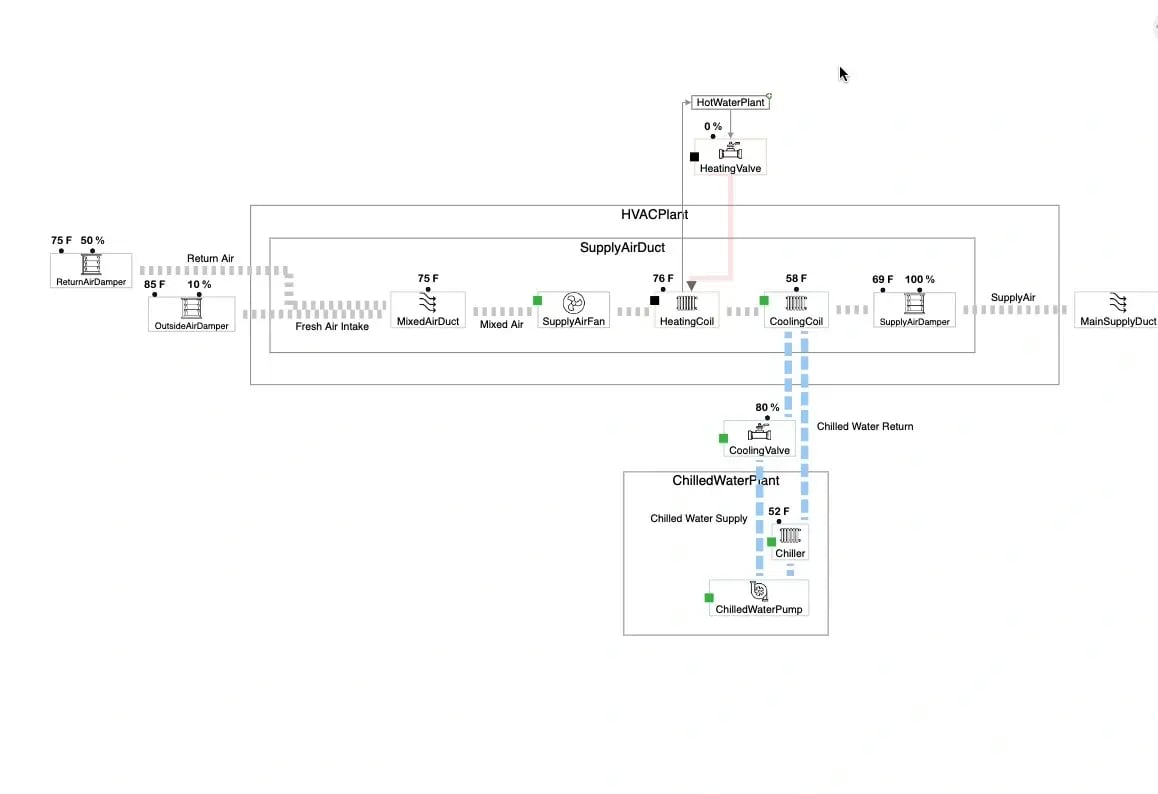
Visualization of a digital twin representing the physical operation and real-time conditions of one heating and ventilation system within a network of connected systems and services.
Lifecycle Optimization and Asset Management
As organizations expand their asset portfolios, lifecycle complexity grows, and multiple vendors, diverse engineering disciplines, and evolving operational conditions introduce fragmentation. A digital twin restores coherence by maintaining a single, continuously updated model of design assumptions, operational behavior, and maintenance history.
With this unified view, decisions about service intervals, component replacement, asset utilization, or load balancing become evidence-based rather than assumption-driven. The twin clarifies how environmental conditions, stress cycles, or usage patterns influence long-term reliability, enabling organizations to extend asset life where feasible and reduce total lifecycle cost without compromising safety or performance.
Scenario Simulation for Strategic Decision-Making
Scenario simulation elevates the digital twin from an engineering tool to a strategic planning instrument. Instead of modeling phenomena in isolation, an enterprise-grade twin evaluates how proposed changes, new schedules, added capacity, modified workflows, and unexpected disruptions ripple through the entire system.
Because the model captures structural dependencies, leadership can assess not only whether a system can accommodate a change, but also how that change affects adjacent processes, resource consumption, and risk exposure. This holistic insight supports confident decisions in domains ranging from manufacturing throughput and energy distribution to transportation planning and safety-critical operations.
Closed-Loop Optimization through AI/ML
A digital twin reaches its full potential when predictive insights inform operational adjustments. In a closed-loop architecture, real-time data updates the model, the model generates optimization recommendations, and those adjustments immediately refine subsequent predictions.
Dependency-aware modeling is essential here. By understanding how local changes influence system-wide behavior, the twin ensures that optimizations, whether adjusting setpoints, routing flows, or redistributing load, enhance global performance rather than create new bottlenecks.
Over time, this feedback cycle improves model fidelity, strengthens predictive accuracy, and transforms the twin into a continuously learning system. Performance, reliability, and operational efficiency improve in parallel as digital and physical behavior evolve together.
Domain-Specific Benefits of Digital Twins
Digital twins have their greatest impact in domains characterized by complexity, interdependence, and the need for rapid, high-confidence decision-making. While the underlying architecture remains consistent, each vertical benefits from the twins’ ability to unify siloed data, reveal hidden dependencies, and visualize system behavior as it unfolds. Graph-based visualization is particularly valuable in these environments because it exposes multi-domain dependencies that are otherwise difficult to detect, providing a structural view of how decisions, constraints, and operational conditions propagate across systems.
Across sectors, government, transportation, energy, manufacturing, aerospace, and urban infrastructure, the digital twin becomes a structural intelligence layer that reveals relationships traditional dashboards cannot capture.
Government and Public Sector:
Operational Dependencies and Preparedness
Public-sector systems often suffer from fragmentation across agencies, programs, and legacy technologies. A digital twin creates an integrated view of policy impacts, resource constraints, and operational flows.
Graph-based visualization reveals cross-department dependencies that influence public safety, emergency response, infrastructure planning, and regulatory workflows. Decision-makers gain the ability to test scenarios, such as policy adjustments or emergency conditions, before committing real-world resources, significantly reducing risk.
Transportation and Mobility:
Network Optimization and Real-Time Flow Insight
Transportation environments rely on tightly coupled networks: vehicles, signals, timetables, sensors, and infrastructure assets all interact continuously.
A transportation digital twin mirrors this dynamic network, providing real-time insight into congestion, routing conflicts, schedule delays, and asset condition.
Visualizing these dependencies exposes choke points and propagation paths, for example, how a delay on one line affects downstream service.
This enables more accurate demand forecasting, better resource allocation, and resilient operations under fluctuating conditions.
Utilities and Energy:
Grid Stability and Predictive Load Management
Energy systems operate as sprawling, interconnected networks in which minor disturbances can trigger cascading failures.
A digital twin of a grid or utility network provides operators with a structural representation of substations, transformers, switching nodes, and distributed energy resources. Visualizing real-time power flows and system topology enables you to see where instability is forming and how different load-balancing strategies would affect the network.
Predictive insights improve maintenance planning, prevent overloads, and support higher penetration of renewable sources.
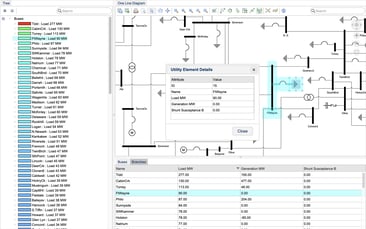
Example grid management screen showing load conditions,
and revealing details of one part of a large electrical grid.
Manufacturing and Industrial Operations:
Line Dependencies and Real-Time Diagnostics
Manufacturing lines contain complex interdependencies where minor deviations propagate through upstream and downstream processes.
A digital twin exposes these relationships by visualizing machine states, cycle times, environmental conditions, and throughput behavior as a unified system.
With dependency structures clearly represented, teams can identify inefficiencies, reduce variability, and prevent unplanned downtime.
The result is a self-correcting operational environment where decisions are made with full awareness of system-wide consequences. Graph-based approaches are uniquely suited to encode, reason about, and visualize these very complex system relationships.
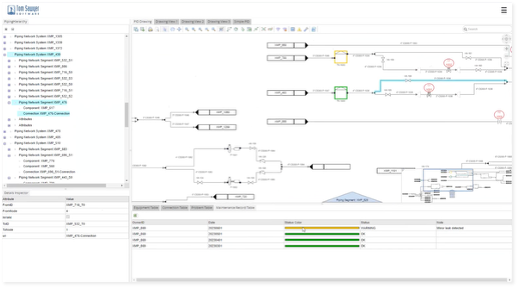
Graph-based visualizations support fully automated and connected views of upstream and downstream systems to support situation awareness and operational integrity in large industrial environments like manufacturing facilities or refineries.
Aerospace and Defense:
System-of-Systems Behavior and Failure Path Analysis
Aerospace and defense platforms contain some of the most intricate engineering systems ever built.
A digital twin calibrated to real operational data enables visualization of how avionics, propulsion, structural components, environmental loads, and software systems interact under changing conditions.
Engineers can trace failure paths across mechanical, electrical, and computational layers, revealing root causes that traditional analysis tools miss.
Scenario modeling enables safer missions, optimized maintenance cycles, and evidence-based certification workflows.
Smart Cities and Infrastructure:
Multi-Domain Coordination and Urban Flow Modeling
Urban environments comprise interdependent networks: mobility, energy, water, communication, public safety, and environmental systems.
A city-scale digital twin unifies these domains, visualizing relationships and exposing how conditions in one system affect another.
Real-time visualization supports immediate decision-making during disruptions, traffic events, infrastructure failures, or environmental hazards, while scenario analysis guides long-term planning for resilience and growth.
Integration with Advanced Technologies
Digital twins reach their highest operational value when complemented by technologies that deepen analytical fidelity, improve real-time accuracy, and expand how teams interpret complex system behavior. AI, IoT, blockchain, and advanced visualization do not change the twin's purpose; they strengthen its ability to represent and influence real-world systems at enterprise scale. These technologies extend the twins’ core architecture, forming an integrated environment that supports continuous learning and data-driven decision-making.
AI and Machine Learning in Model Calibration
AI and ML refine the alignment between digital models and real-world performance. As assets age and operating conditions shift, engineering assumptions naturally drift. Machine learning algorithms continuously analyze telemetry patterns, historical deviations, and contextual factors to detect subtle changes that may not be visible through manual inspection.
AI does not replace engineering judgment; it reinforces it. When calibration insights feed into structured, dependency-aware models such as graph-based or semantic representations, the adjustment process becomes transparent and traceable. This keeps simulations accurate, strengthens predictive maintenance, and ensures that twin behavior reflects both design intent and evolving operational realities.
Role of IoT and Sensor Fusion
IoT systems supply the raw signals that keep a digital twin synchronized with the physical environment. However, enterprise data often arrives at different sampling rates, with inconsistent quality or partial reliability. Sensor fusion resolves these differences by validating inputs, correcting drift, reconciling redundant readings, and filtering noise to reveal the system's actual physical state.
When synthesized within a structured modeling environment, fused data improves situational awareness and allows the twin to represent not only isolated values but also the interactions that define system behavior. This is especially critical in safety-focused and continuity-driven industries, where trustworthy, real-time insight underpins every operational decision.
Advanced Visualization of System Understanding and Operational Insight
Advanced visualization is the interpretive core of sophisticated digital twin environments. Unlike traditional dashboards that present isolated metrics, visualization reveals structure: how components depend on each other, how changes propagate, and where risks or inefficiencies emerge.
Graph-based visualization is compelling because it exposes the system’s authentic architecture—nodes, interfaces, constraints, and cross-domain relationships. When combined with real-time telemetry and model semantics, it allows engineers to trace anomalies to their root cause, evaluate the impact of operational decisions, and detect bottlenecks that numerical analysis alone cannot uncover.
In this role, visualization serves as the connective tissue of the enterprise twin, linking operational data, engineering logic, and decision-making processes into a coherent analytical environment.
Strategic Deployment Considerations
Deploying a digital twin at enterprise scale requires far more than connecting data sources or selecting modeling tools. Mature implementations depend on stable architectural principles, standards that preserve interoperability, governance structures that protect data integrity, and the ability to scale across heterogeneous systems without fragmenting the operational model. In this context, the digital twin becomes part of the enterprise architecture itself, embedded within data pipelines, engineering workflows, simulation environments, and decision-making processes. Visualization supports this ecosystem by providing a clear window into how these architectural elements interact and how well the deployment behaves in practice.
Interoperability and Standards
(ISO, OPC UPA, FMI)
Interoperability is the foundation of any digital twin ecosystem that must outlive a single project generation. Without consistent ways to exchange data and represent system behavior, models quickly become isolated and lose operational relevance. Industry standards, ISO lifecycle frameworks, OPC UA for industrial communication, and FMI for model exchange and co-simulation enable organizations to integrate tools, vendors, and engineering domains without reinventing interfaces at every transition.
When a twin is grounded in a structured, dependency-aware representation, interoperability extends beyond compatibility. It allows engineering assumptions to remain consistent across disciplines and enables the federation of models developed by different teams or suppliers. Visualization amplifies this by making semantic alignment visible: engineers can immediately see how imported elements relate to existing structures, whether assumptions conflict, or where gaps need reconciliation. This clarity is essential for long-term scalability.
Cybersecurity and Data Governance
As digital twins evolve into operationally critical systems, cybersecurity and governance must be integrated directly into their architecture. Twins often aggregate data from assets never designed for external connectivity, creating new exposure points that require careful management. Governance frameworks define data ownership, access rights, and provenance tracking while separating operational and engineering data flows.
Visualization plays a pivotal role here as well. By illustrating how data moves through the system, where it originates, how it is transformed, and where it is consumed, it becomes easier to assess risk surfaces and validate whether safeguards function as intended.
Dependency-aware models further support this effort by exposing how unauthorized changes could propagate and by making integrity checks more intuitive. In safety-critical sectors, this transparency becomes indispensable for compliance and assurance.
Scalability in Multi-Asset Environments
Scaling from a single digital twin to an enterprise-wide deployment introduces challenges related to model variability, data heterogeneity, and computational load. A scalable architecture does not replicate modeling logic for each asset; it relies on reusable structures, shared semantics, and consistent representations of dependencies. This approach reduces engineering overhead, prevents divergence across models, and preserves interpretability as the system grows.
Graph-based representations are particularly effective for handling scale. They clarify how behavior in one part of the ecosystem influences another, whether in manufacturing equipment, distributed energy assets, transportation fleets, or city infrastructure. Visualization of these relationships prevents the architecture from becoming opaque, allowing teams to understand system-wide implications even as new assets or processes are added.
Cloud-Native vs. On-Prem Twin Deployment
Choosing between cloud-native and on-prem deployment models depends on latency requirements, regulatory constraints, data sovereignty, and existing infrastructure. Cloud-native twins excel at handling large-scale analytics, machine learning calibration, and simulation workloads that require elastic compute resources. They are well-suited for organizations seeking centralized orchestration or broad historical analysis.
On-prem deployments remain essential in environments where real-time responsiveness, strict security controls, or local data residency requirements dictate physical proximity to operational assets. These setups benefit from predictable latency and granular control over internal data pathways.
Most enterprises ultimately adopt a hybrid architecture, where edge systems manage time-sensitive analytics and control logic, while cloud services support broader lifecycle modeling and cross-domain optimization. Visualization provides a unified interpretive layer across this hybrid environment, enabling teams to observe how edge and cloud components interact, whether they remain synchronized, and how decisions propagate through the system.
Key Challenges and Risk Mitigation
Even the most sophisticated digital twin will underperform without a clear understanding of the structural, organizational, and operational challenges that shape its behavior. In enterprise environments, these challenges emerge not from modeling limitations but from the realities of distributed data, system evolution, and the need to preserve fidelity under constantly changing conditions. Addressing them requires disciplined architecture and a holistic view of how interconnected systems behave in practice.
Data Latency and Bandwidth Constraints
Digital twins rely on the timely movement of data between physical assets and computational layers. When network congestion increases or telemetry loads become heavy, latency distorts the twins’ interpretation of real-world conditions. In fast-moving systems, manufacturing lines, logistics networks, or electrical grids, even seconds of delay can undermine predictive accuracy. The most effective mitigation strategy is a tiered architecture in which time-critical processing occurs at the edge while the cloud manages broader analytics. This keeps the twin responsive without overwhelming it with unnecessary signal noise.
Digital Twin Model Drift
Over time, real-world systems evolve in ways that original engineering models cannot fully anticipate. Components age, operating conditions shift, and environmental influences accumulate. Without continuous recalibration, the digital representation drifts away from reality, reducing the reliability of its insights. High-fidelity twins avoid this by persistently comparing predicted and observed behavior, automatically refining model parameters, and using structured representations, such as graph-based dependencies, that reveal where deviations originate and how they influence the rest of the system.
Organizational Resistance and Change Management
Technical capability alone does not ensure successful adoption. Digital twins can introduce new workflows, challenge legacy processes, and require cross-functional alignment that some teams initially resist. If the twin is perceived as intrusive or disconnected from real operational concerns, it risks being underused. Adoption improves when the twin is framed not as a replacement for expertise but as a system that clarifies complexity and strengthens decision-making. Transparent governance, predictable workflows, and clear communication about value help teams integrate the twin into daily operations with greater confidence.
Conclusion
Digital twins deliver their most significant value when they serve as the structural lens through which organizations understand how their systems truly behave, how they perform, where they fail, and where improvement is possible. Their power lies not in individual technologies but in the coherence created when real-time data, engineering models, and operational insight converge into a unified analytical environment. At that point, the twin shifts from a parallel representation of reality to an active decision-support system that guides teams toward more predictable, resilient choices.
Achieving this maturity depends on architectural discipline: a consistent digital thread, reliable data flows, clear dependency structures, and visualization frameworks that expose complexity without oversimplifying it. When these elements work together, long-standing operational challenges, fragmentation, blind spots, reactive maintenance, and slow decision cycles begin to diminish as the twin becomes a stable source of truth across engineering and operations.
For technical leaders, the opportunity lies in creating a foundation that supports continuous improvement. Digital twins enable the move from episodic understanding to persistent awareness, from isolated analyses to system-level reasoning, and from reactive intervention to proactive optimization. They create the conditions for informed innovation, where decisions are shaped not only by data but by a deep structural understanding of how the entire system functions.
Ultimately, a digital twin is not just a tool. It is a long-term architectural asset. When built on interoperable standards, grounded in trustworthy data, and integrated into real operational workflows, it becomes a critical mechanism for navigating complexity and evolving confidently as systems, technologies, and business environments change.
About the Author
Caroline Scharf, VP of Operations at Tom Sawyer Software, has 15 years experience with Tom Sawyer Software in the graph visualization and analysis space, and more than 25 years leadership experience at large and small software companies. She has a passion for process and policy in streamlining operations, a solution-oriented approach to problem solving, and is a strong advocate of continuous evaluation and improvement.
AI Disclosure: This article was generated with the assistance of artificial intelligence and has been reviewed and fact-checked by Caroline Scharf and Liana Kiff.
Frequently Asked Questions
How do digital twins enable zero-downtime operation?
Digital twins maintain a continuously synchronized view of the physical system, allowing early detection of degradation long before it becomes operationally visible. Rather than functioning as static replicas, they correlate real-time telemetry with historical behavior to surface subtle deviations.
When the twin is built on dependency-aware models, such as graph-based or model-driven structures, it can simulate how a localized anomaly may propagate through the system. This enables teams to schedule maintenance at optimal times, redistribute load proactively, and intervene before performance degrades.
Zero-downtime operations emerge not simply from rapid reactions, but from understanding how stress and failure evolve across interconnected components.
What are the key differences between digital twins and system emulators?
Although often grouped together, digital twins and emulators serve different purposes. A system emulator reproduces predefined behavior and typically has no live connection to a physical asset. It is used for development, testing, or training within controlled scenarios.
A digital twin maintains a continuous, data-driven relationship with its real-world counterpart. It updates in real time, incorporates mechanical, electrical, software, and process domains, and evolves as conditions change. Most importantly, it predicts future states based on current dependencies, capabilities that an emulator does not provide.
In practice, emulators support design and testing, whereas digital twins support ongoing operations, oversight, and optimization.
How does synthetic data improve twin performance?
Synthetic data expands the range of conditions a digital twin can learn from, especially when real-world data is scarce, imbalanced, or lacks rare but impactful events. By generating simulated or model-based datasets, teams can expose the twin to extreme, unusual, or combined scenarios that have not yet occurred in live operations.
When incorporated into a dependency-aware structure, synthetic data strengthens pattern recognition, improves prediction of edge-case failures, and enhances scenario modeling. This ensures the twin remains reliable even as real data varies or fails to capture the full operational spectrum.
How does advanced visualization enhance the effectiveness of digital twins?
Advanced visualization reveals the structural context of system behavior, something raw data alone cannot provide. In complex enterprise systems, performance depends on interactions across many interconnected components, and visualization makes these relationships explicit.
Graph-based or model-driven visual frameworks allow engineers to trace how conditions in one area affect others, identify potential failure paths, and recognize cascading effects early. This clarity is essential for diagnostics, scenario simulations, and decision-making.
Visualization also provides a standard interpretive frame for engineering, operations, and leadership, reducing misalignment and accelerating analysis. In effect, it transforms the digital twin from a reactive monitoring tool into a strategic decision platform.
Submit a Comment