

Max Chagoya
Digital twin applications create the most value when they do more than simulate or visualize a system. In complex operational environments, they must help maintain the current system state, interpret changes as they happen, and support decisions that account for downstream impact.
This shift matters because enterprise systems already generate large volumes of telemetry, events, and historical records. The limiting factor is no longer data availability. It is whether that data can be synchronized, structured, and interpreted in a way that reflects how the system actually behaves under live conditions.
That is why execution has become the defining requirement. A digital twin that cannot reason about dependencies, evaluate changes in context, and stay aligned with current operating conditions remains useful for observation but is limited in operational decision support. Execution-grade digital twin applications depend on an explicit system model that can represent relationships, maintain live state, and support impact-aware reasoning as conditions evolve.
Why Digital Twin Applications Require System-Level Execution (Not Just Simulation or Monitoring)
Simulation and monitoring are useful, but neither is sufficient when a digital twin application must support live operational decisions. In complex environments, a local change can quickly affect throughput, safety, resource allocation, or service continuity across connected systems.
That is why the most valuable digital twin applications depend on execution-aware models that preserve operational context and make downstream impact visible. Graph-based execution supports this by allowing applications to evaluate change across dependencies and help users act on current system conditions rather than isolated signals.
Enterprise Digital Twin Applications as Execution Systems
Enterprise digital twin applications create value when live system state, dependency-aware reasoning, and operational decision support come together in a single environment. In practice, this becomes most visible in applications such as predictive maintenance, operational risk analysis, process optimization, and real-time monitoring with execution context.
Predictive Maintenance Across Interconnected Assets
Predictive maintenance becomes more system-aware when assets are modeled within an interconnected operational environment. In asset-heavy settings, failures rarely remain isolated; they spread through shared resources, process dependencies, and operational constraints.
Execution-grade digital twins continuously correlate live sensor signals with executable system models to detect early indicators of degradation. These signals are evaluated not only against expected component behavior, but also in the context of upstream and downstream dependencies. A deviation in one asset is assessed by its impact on throughput, quality, safety margins, and operational criticality elsewhere in the system.
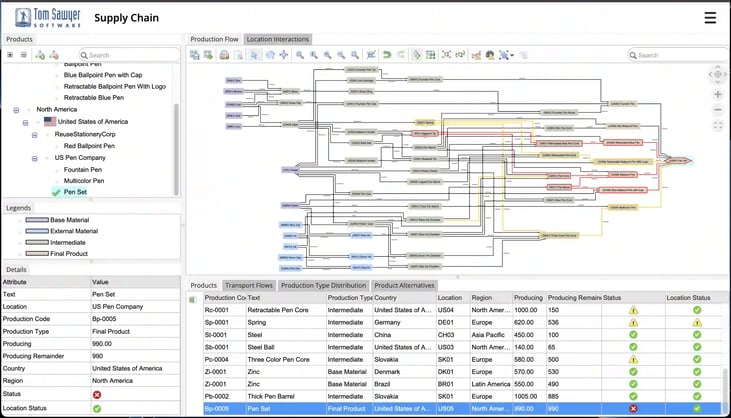
Supply chain illustration showing how a system failure at one plant can delay parts and production at many other locations downsteam.
This system-aware perspective enables dynamic prioritization of maintenance decisions. Maintenance interventions are guided not only by asset-level thresholds but also by their broader operational impact. The digital twin evaluates when and where action will matter most, helping minimize disruption and prevent cascading failures across interconnected assets. In practice, this requires continuous ingestion of sensor and operational event streams into a live graph model, a capability that Tom Sawyer Data Streams provides by maintaining an always-current knowledge graph from Kafka-based telemetry sources.
Operational Risk Analysis in Complex Systems
Operational risk in complex systems is shaped less by isolated component failures than by evolving dependencies, constraint interactions, and non-obvious escalation paths. Traditional risk assessment methods often rely on static scenarios or historical incident patterns, making them poorly suited to real-world operational environments where system conditions change continuously.
Execution-grade digital twins improve this by embedding risk evaluation directly into the live system model. As conditions change, the twin can assess how risk exposure shifts across connected assets, processes, and constraints, helping operators identify where a local issue could become a broader operational threat.
This supports earlier and more targeted intervention. Instead of treating risk as a periodic assessment exercise, organizations can evaluate it continuously in the context of current system conditions, enabling mitigation strategies better aligned with actual operating realities.
Process Optimization Through Dependency Modeling
Process optimization efforts frequently fail when they focus on local efficiency gains without accounting for system-wide constraints. In complex production and infrastructure environments, improving one process step can degrade performance elsewhere if dependencies are not explicitly modeled.
Execution-grade digital twins address this by treating processes as interconnected flows governed by shared constraints. Dependency modeling makes bottlenecks, coupling points, and constraint interactions visible and executable. Optimization strategies are evaluated against the full system model, not just isolated performance metrics.
As conditions evolve due to demand variability, equipment availability, or resource constraints, the digital twin can re-evaluate optimization strategies in real time. This enables continuous alignment between operational objectives and actual system behavior, preventing local improvements from introducing systemic inefficiencies or instability.
Real-Time Monitoring Integrated with System Execution and Decision Logic
Real-time monitoring becomes operationally valuable only when it helps users decide what matters, why it matters, and what to do next. Metrics alone rarely provide that clarity. In complex environments, they often increase cognitive load by forcing operators to infer relevance, dependency impact, and response priority on their own.
Execution-grade digital twins improve this by embedding monitoring inside a live system model. Alerts and deviations are not interpreted as isolated readings. They are evaluated against the current system structure, active constraints, and affected dependencies. This makes it possible to distinguish between a local anomaly, a developing bottleneck, and a condition likely to propagate across the wider environment.
That shared execution context improves both human and automated decision-making. Operators can inspect why a condition is important, which dependencies are affected, and where intervention will have the greatest effect. Automated processes can act within defined authority boundaries using the same system-level view. Tom Sawyer Perspectives supports this model by enabling graph-based applications in which live state, dependency paths, and impact relationships remain continuously visible and navigable, by both human and automated agents.
Digital Twin Applications Across Industries
Digital twin applications share a common architectural requirement across industries: they must remain synchronized with current operating conditions and reason over dependency structure in context. What changes from one industry to another is not the need, but the execution profile around it.
Latency tolerance, regulatory burden, operational coupling, safety exposure, and coordination complexity vary significantly by domain. As a result, digital twin applications must be designed differently in energy networks, transportation systems, and public-sector environments. The sections below focus on how industry conditions shape execution requirements in practice.
Energy and Utilities
Energy and utility environments depend on continuous coordination across generation assets, transmission infrastructure, distribution networks, and shifting demand conditions. In these systems, the operational challenge is not only visibility into asset status, but maintaining grid stability, service continuity, and resilience as conditions change across the network.
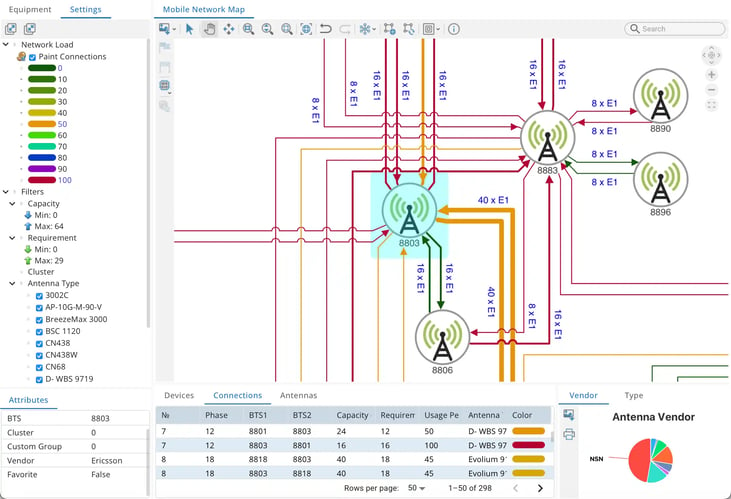
Graph-based visualization and analysis of real-time microwave network bottlenecks supports short-term mitigation strategies as well as long-term planning for network growth and maintenance.
Digital twin applications in this domain must support fast evaluation of load shifts, equipment degradation, outage risk, and maintenance actions within the broader operational context. When the system is modeled as a live dependency structure, operators can assess how local disturbances may affect redundancy, balancing, restoration priorities, and regulatory operating thresholds before taking action.
This execution model supports more proactive grid management under dynamic conditions, especially where reliability, safety, and coordinated response are tightly linked.
Transportation and Logistics
Transportation and logistics systems depend on continuous coordination across routes, hubs, vehicles, schedules, and capacity constraints. In these environments, a local disruption rarely stays local for long. A delayed departure, blocked route, or constrained hub can quickly create knock-on effects across connected operations.
Digital twin applications in this domain must support rapid evaluation of rerouting options, schedule adjustments, asset availability, and hub-level bottlenecks within the broader network context. When the system is modeled as a live operational graph, operators can assess how a change in one part of the network may affect downstream timing, resource allocation, and service continuity before disruption spreads further.
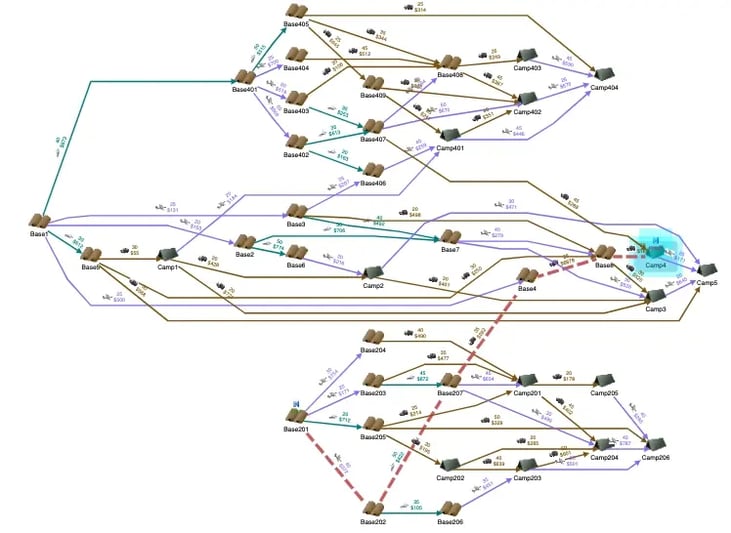
A supply logistics planning module illustrating optimal and alternative supply paths.
This execution model supports a more coordinated response under volatile conditions, helping organizations reduce cascading delays, improve recovery decisions, and maintain network resilience when operating conditions shift.
Government and Public Sector
Public-sector systems, such as transportation infrastructure, utilities, emergency response networks, and urban services, are characterized by high interdependencies, long asset lifecycles, and strict accountability requirements.
Digital twin applications in this context emphasize traceable decision logic and transparent system reasoning. By maintaining an explicit, continuously updated graph of assets, services, and constraints, public agencies can evaluate policy decisions, infrastructure changes, or emergency responses in terms of system-wide impact.
Real-time event streaming ensures that dependency visualization and impact analysis remain grounded in live operating conditions, supporting coordinated response across departments and jurisdictions.
Tom Sawyer Software's graph-based solutions are available to U.S. federal, state, and local agencies through a partnership with Carahsoft Technology Corp., making graph-powered digital twin capabilities accessible via established public-sector procurement vehicles, including SEWP V, ITES-SW2, and NASPO ValuePoint. This procurement infrastructure reduces adoption barriers for agencies evaluating execution-grade digital twin applications in mission-critical environments.
Where Digital Twin Applications Break Down Without Execution Context
Digital twin applications break down when they cannot preserve execution context across connected systems. In those situations, teams may see that something changed, but not why it matters, how far the impact may spread, or where action will have the greatest operational effect.
This is where graph-based execution becomes especially important. By keeping dependencies explicit and operational, it allows applications to interpret change within the broader system rather than as a disconnected event, improving the quality and speed of downstream decisions.
Local Signals Without System Context
Digital twin applications lose value when they surface alerts, deviations, or optimization opportunities without showing how those conditions affect the wider system. In practice, teams need more than visibility into individual metrics. They need to understand which dependencies are affected, what the likely downstream impact is, and where intervention will matter most.
Graph-based execution improves this by keeping relationships explicit and operational, enabling applications to interpret local changes within the broader system context.
Slow Decisions in Tightly Coupled Environments
In tightly coupled environments, the value of a digital twin application depends on how quickly it can support a meaningful response. A maintenance issue, route disruption, load imbalance, or process bottleneck can escalate quickly when the downstream impact is not evaluated early.
Applications built on explicit dependency models reduce this gap by supporting faster impact analysis and more coordinated decisions under live conditions.
Choosing a Platform for Execution-Grade Digital Twin Applications
Selecting a platform for digital twin applications is an architectural decision, not just a tooling choice. At execution grade, the platform determines whether the twin remains an analytical layer around the system or becomes part of real-time operational reasoning.
The most effective platforms treat structure, state, and execution as core requirements. They must support explicit dependency modeling, continuous synchronization with live conditions, and transparent decision support at enterprise scale.
Why Graph-Based Modeling Matters
A platform for digital twin applications must preserve the dependency structure through which operational impact moves. This matters because applications such as maintenance prioritization, risk evaluation, and real-time monitoring depend on understanding how changes affect connected assets, constraints, and processes.
Graph-based platforms support this directly by making relationships visible, queryable, and operational within the application itself.
Scalability, Governance, and Auditability
As digital twin applications expand across assets, sites, and organizational boundaries, non-functional requirements become as critical as modeling capability. Platforms must scale not only in data volume, but in decision scope, accountability, and control.
Scalability at execution grade depends on localized computation and incremental state propagation. Effective platforms process changes where they occur and then propagate their impact selectively along relevant dependency paths. This approach preserves performance while maintaining system-level awareness.
Equally important is governance. Execution-grade digital twins influence operational decisions, often with safety, financial, or regulatory implications. Platforms must support controlled model evolution, traceable decision logic, and role-aware access to system state and actions. Every recommendation or automated intervention should be inspectable with respect to the data, relationships, and rules that produced it.
Auditability completes the picture. As digital twins become part of operational control loops, organizations must be able to reconstruct system state, understand why decisions were made, and demonstrate compliance. Platforms that treat execution as opaque analytics fail this test. Platforms that embed structure, state, and decision logic into a unified, inspectable model enable transparency without sacrificing performance.
For organizations evaluating how to implement these capabilities in practice, Tom Sawyer Software offers a structured proof-of-concept engagement that demonstrates graph-based digital-twin integration using the client's operational data. The engagement connects sample data sources to a Perspectives-based graph application, enabling evaluators to navigate system dependencies, and evaluate impact, typically within three weeks. This provides a concrete foundation for assessing execution-grade digital twin architecture before committing to full deployment.
Final Thoughts: From Digital Twins to Execution Systems
The strongest digital twin applications are the ones that improve real decisions under live operating conditions. Their value does not come from visualization alone, but from the ability to interpret change in context, evaluate downstream effects, and support coordinated action across connected systems.
For organizations evaluating digital twin strategy, the key question is not how many dashboards a platform can produce, but whether applications built on it can maintain context, reason over dependencies, and support confident action in complex environments.
About the Author
Max Chagoya is Associate Product Manager at Tom Sawyer Software. He works closely with the Senior Product Manager performing competitive research and market analysis. He holds a PMP Certification and is highly experienced in leading teams, driving key organizational projects and tracking deliverables and milestones.
AI Disclosure: This article was generated with the assistance of artificial intelligence and has been reviewed and fact-checked by Caroline Scharf and Liana Kiff.
FAQ
What are the top applications of digital twins?
At enterprise scale, common applications include predictive maintenance, real-time operational monitoring, system-level optimization, and scenario evaluation under changing constraints. The more advanced applications go further by reasoning over dependencies, propagating state changes, and evaluating downstream impact as conditions evolve.
Which industries benefit most from digital twins?
Industries with complex, tightly coupled systems benefit most from digital twins. This includes energy and utilities, manufacturing, transportation, logistics, aerospace, and the public sector. In these environments, localized changes can propagate quickly across assets, processes, and operational constraints, making real-time system understanding especially valuable.
Can digital twins improve decision-making?
Yes, when they are designed as execution systems rather than passive monitoring layers. By maintaining a current model of system structure and state, digital twins allow decisions to be evaluated against live conditions and likely downstream effects.
How does Tom Sawyer Software support execution-grade digital twin applications?
Tom Sawyer Software provides the graph-based infrastructure needed for execution-grade digital twin applications. Tom Sawyer Data Streams ingests and links operational events in real time into an always-current graph model, while Tom Sawyer Perspectives enables organizations to build applications that visualize dependencies, navigate live system state, and analyze impact across connected structures. Together, they support a shift from passive monitoring to active system reasoning.
How are graph-based digital twins applied in industrial and manufacturing environments?
Graph-based digital twins in industrial environments maintain real-time synchronization between production events and a live dependency graph, enabling immediate evaluation of bottlenecks, constraint violations, and downstream impacts as conditions change. This supports dynamic reconfiguration of production strategies, predictive maintenance based on actual asset condition, and throughput optimization across interconnected production assets. For a detailed treatment of digital twins in manufacturing, see our article on digital twins in manufacturing.
Submit a Comment