

Liana Kiff
Digital engineering is an approach to understanding and managing modern engineered systems that reflects how they are built and operated today. As systems become more software-driven, interconnected, and long-lived, organizations increasingly face challenges that traditional engineering methods often struggle to address.
Across many industries, engineers must work with systems whose structure and behavior span multiple domains and evolve continuously over time. Under these conditions, maintaining clarity about how systems are organized and how decisions affect outcomes becomes progressively more difficult.
This article examines digital engineering as a response to these challenges, outlining what the discipline entails, why it has become necessary, and how organizations apply it to reason more effectively about complex systems.
Digital Engineering Definition
There are several official definitions of digital engineering For the purpose of this article it is useful to view digital engineering as the discipline of creating and maintaining a coherent, connected representation of a system that integrates models, data, structure, and behavior to support analysis and decision-making across the system lifecycle.
Digital engineering maintains models, simulations, and documentation as interrelated elements of a persistent and authoritative digital representation of the system. This abstract representation evolves alongside the real system, preserving explicit relationships, constraints, and dependencies as design decisions are implemented and operating conditions change.
A key concept in digital engineering is the digital thread. There are many official definitions of a digital thread, but here we will describe it as the authoritative set of connected relationships that represent the flow of system information across lifecycle stages, engineering disciplines, and organizational boundaries. The digital thread preserves context and traceability as requirements, architectures, models, analyses, implementations, and operational data evolve, helping organizations understand how decisions propagate through the system over time.
In practical terms, digital engineering enables organizations to reason about systems as unified structures composed of connected elements. It provides a basis for understanding how changes propagate across architectural, behavioral, and operational boundaries, and for evaluating decisions in the context of the current system state and evolving operating conditions.
Digital engineering is therefore not defined by a single tool or platform. It is defined by the ability to consistently connect to, navigate, and interpret system information at scale, while maintaining alignment among system intent, implementation, and operational reality as the system evolves.
Digital engineering is not simply an application of new technology to an old problem. Successful adoption of digital engineering includes preparing the organization for the cultural transformation required to make a digital engineering initiative successful.
Why Digital Engineering Matters Today
Digital engineering is becoming increasingly necessary because traditional engineering approaches struggle to maintain a coherent understanding of systems at scale. As systems grow larger, more interconnected, and increasingly software-defined, the gap between how systems are designed and how they behave in operation becomes a structural feature of complexity.
Many organizations still rely on methods optimized for an era when systems could be cleanly decomposed, independently analyzed, and exhaustively documented. In modern environments, this assumption no longer holds. A change in one part of the system, particularly in software, can propagate across hardware constraints, operational procedures, safety assumptions, and regulatory boundaries in ways that static documentation can be difficult to capture or evaluate.
A critical limitation is fragmentation. Models, simulations, and operational data are created in separate tools, owned by different teams, and expressed at incompatible levels of abstraction. Even when these artifacts are individually correct, the absence of explicit connections between them makes holistic reasoning difficult. Engineers and decision-makers are forced to manually assemble context, often relying on partial or outdated views when evaluating trade-offs or responding to change.
Equally significant is the erosion of shared understanding of the system. As organizations scale, expertise becomes distributed across teams and roles, and no single individual retains a complete mental model of the system. Traditional approaches implicitly depend on such individual understanding to bridge gaps between artifacts. At scale, that dependency fails.
Digital engineering matters today because system complexity has reached levels where these failure modes become increasingly common and difficult to avoid. At some point, intuition, documentation, and static diagrams are no longer sufficient to support safe, timely, and scalable decision-making in complex systems.
How Digital Engineering Supports System-Level Reasoning and Insight
At scale, the central challenge of digital engineering is not producing more accurate artifacts but enabling reliable system-level reasoning under continuous change. As systems evolve across design, implementation, and operation, understanding must remain grounded in an explicit structure that can be inspected, navigated, and shared across the enterprise.
Digital engineering addresses this challenge by maintaining connected system representations in which relationships, dependencies, constraints, and assumptions remain visible over time. These representations provide a foundation for understanding how changes propagate across architectural, behavioral, and operational boundaries, allowing engineers and stakeholders to evaluate decisions in the context of the current system state.
Semantic Foundations for System Reasoning
System-level reasoning depends not only on relationships between elements, but on the meaning of those elements and relationships. Digital engineering environments must preserve both engineering semantics and domain-specific semantics so that models remain interpretable as systems evolve.
- Engineering semantics describe how system elements relate within the engineering process, including concepts such as allocation, dependency, verification, interface definition, and requirement satisfaction.
- Domain semantics describe what modeled elements represent within their operational context.
- An aerospace system may incorporate flight control functions, avionics, propulsion systems, mission objectives, and certification constraints.
- A refinery may incorporate process units, material flows, safety barriers, and operating limits.
Large engineered systems frequently span multiple domains simultaneously, requiring these concepts and their relationships to remain coherent across the federated system representations.
When these semantics remain explicit, engineers can reason not only about whether elements are connected, but about the significance of those connections within the broader system context. This provides the foundation for impact analysis, traceability, trade-off evaluation, and informed decision-making across complex systems.
Shared Understanding and Decision Support
One of the most important outcomes of digital engineering is the creation of a shared system reference. When models, data, and domain knowledge are connected within a coherent representation, stakeholders from different disciplines can work from the same underlying system structure even when their concerns and levels of abstraction differ. Alignment no longer depends primarily on translating information between documents, models, and teams, but on direct interaction with shared system representations.
This shared understanding improves how validation, trade-offs, and future decisions are approached. Teams can evaluate alternatives based on systemic impact, including how changes alter constraints, propagate through dependencies, and influence downstream behavior. Trade-offs become more explicit, assumptions more transparent, and decisions more closely tied to the current state of the system.
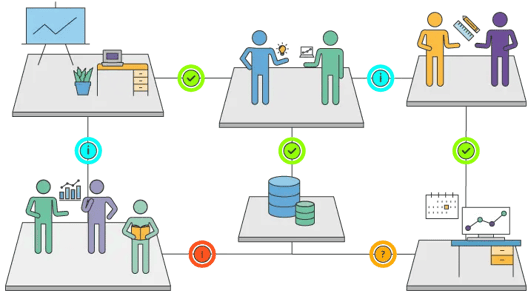
Digital engineering can help teams develop solutions based on long-term impacts and trends.
The same characteristics that support human understanding also increasingly support the emerging AI-assisted engineering workflows. As engineering knowledge becomes more connected, semantically explicit, and traceable, AI systems can help engineers explore system relationships, identify potential impacts, summarize complex model structures, and surface relevant information during decision-making. The effectiveness of these capabilities depends on the quality and coherence of the underlying system representations, reinforcing the importance of maintaining connected and interpretable engineering knowledge.
As a result, organizations can evolve complex systems more intentionally, preserving coherence while adapting to new requirements, risks, technologies, and operating conditions.
Core Capabilities of Digital Engineering
Sustaining digital engineering over time depends on a set of core capabilities that preserve system understanding as complexity, change, and organizational boundaries increase. These capabilities determine whether models and data continue to support reasoning or gradually degrade into disconnected artifacts.
They also provide the basis for interoperability across existing engineering practices. When they are present, system information remains interpretable, navigable, and trustworthy across disciplines and lifecycle stages. Without them, even technically correct models lose practical value as systems evolve.
System Modeling and Behavioral Representation
A core capability of digital engineering is representing system structure and behavior in a form that supports meaningful reasoning about the system. This includes architectural elements, interfaces, dependencies, and constraints, as well as dynamic aspects such as state changes, interactions, and operational scenarios.
At scale, the central challenge is preserving the semantic integrity of models as the system changes. Models must retain intent, relationships, and behavioral assumptions as implementation details, configurations, and operating conditions evolve. Without this continuity, they cease to function as active instruments for understanding the system and recede into historical documentation.
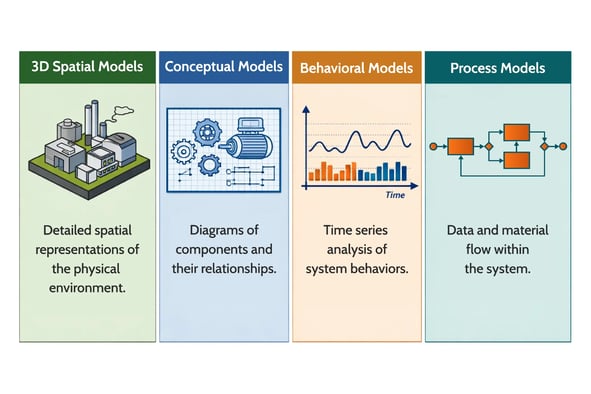
Digital engineers can use different types of models to build solutions in multiple industries.
Behavioral representation is especially critical in complex systems, where behavior emerges through interactions across the system. Digital engineering depends on making those interactions explicit and explorable so that emergent effects can be understood before they surface as operational problems.
Model-Based Systems Engineering Environments
Model-Based Systems Engineering provides the formal structure needed to rigorously and consistently capture system requirements, architecture, and behavior. Within digital engineering, MBSE environments often serve as the authoritative source of system definition.
However, as systems scale, formal correctness alone is insufficient. Large SysML models often contain thousands of interconnected elements, making their value dependent on how effectively they can be accessed, navigated, and interpreted by different stakeholders. If understanding is limited to a small group of specialists, system knowledge becomes fragile. MBSE provides a formal layer and guildelines for describing any system, but other semantics and standards are required to make each object and connection interpretable in the context of specific discplines (e.g., aerospace) and of the wider world.
Digital engineering builds upon MBSE by connecting model-based practices with operational data, lifecycle information, governance, and enterprise-wide decision support. This requires environments that support cross-model navigation, comparison, and exploration, keeping system meaning accessible across teams, disciplines, and lifecycle phases.
Graph-Based System Visualization and Analysis
As systems grow in size and interconnectedness, understanding increasingly depends on both system elements and the relationships between them. Graph technologies provide one particularly effective way to represent and analyze the dense relationships found in large engineering systems.
Graph-based visualization enables engineers to navigate complex systems dynamically by following dependencies, filtering context, and examining structure as questions arise. Engineers can explore the system interactively and adapt their view to the decision or issue under examination.
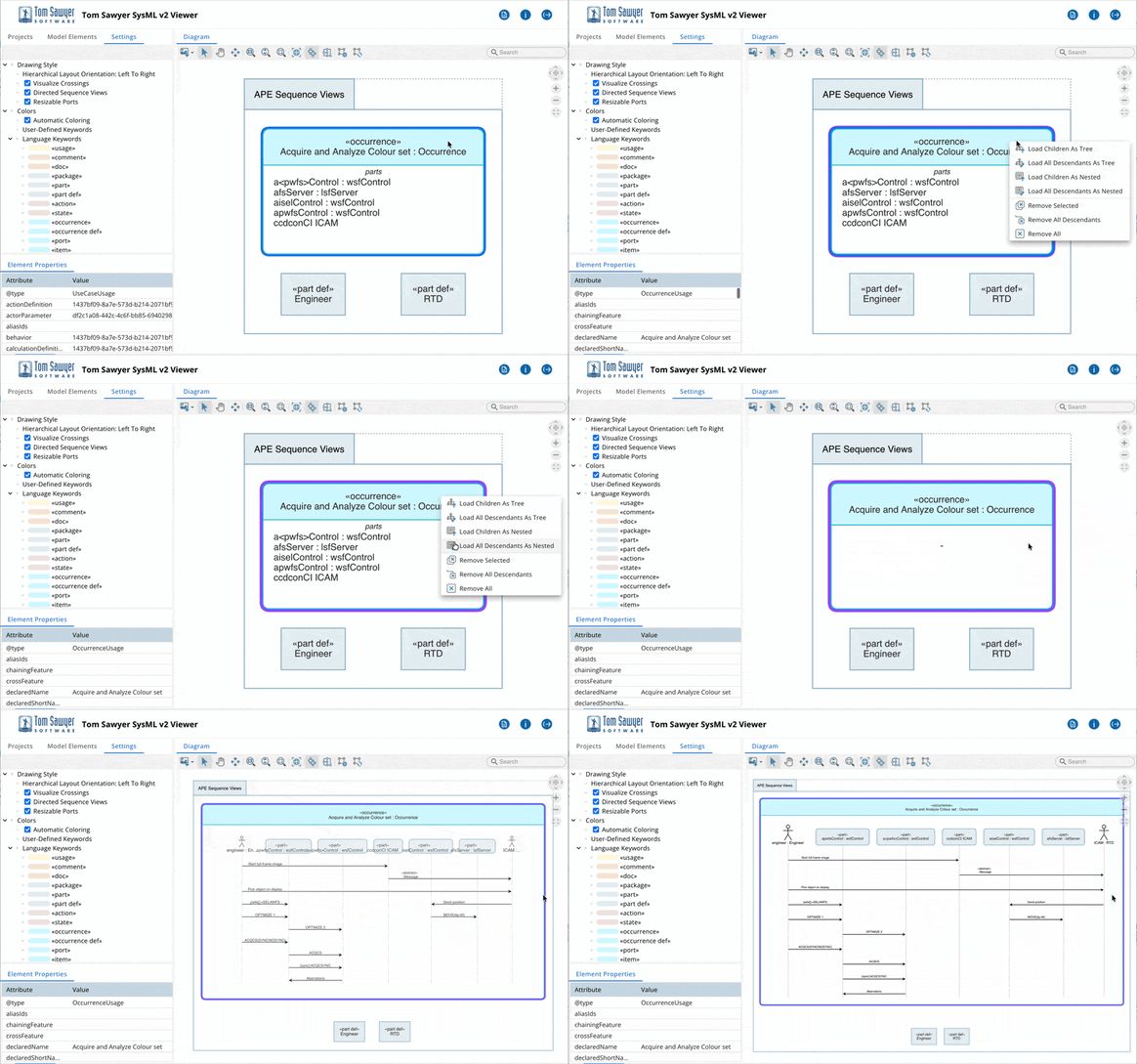
Digital engineers can use graph visualization layout tools to efficiently work with complex systems.
Crucially, visualization in this context serves an analytical function. It supports reasoning about structure, behavior, and change. Scalable layouts and meaningful abstractions help engineers identify patterns, assess impact, and compare system states over time. Without this capability, complexity remains implicit and difficult to examine directly.
Digital Twin and Live System Context
Modern digital twins typically combine operational data, simulation, analytics, and predictive models to support monitoring, forecasting, and operational decision-making. In doing so, they give engineers a continuously updated basis for reasoning about the current system state and evaluating decisions in the context of active system conditions.
The value of a digital twin lies in preserving relationships, not in mirroring physical detail. When structural and behavioral relationships remain intact, operational data can be interpreted meaningfully in context, supporting analysis of system behavior as conditions change.
In this way, digital engineering and digital twins converge around a shared requirement: maintaining coherence between models, data, and real-world behavior over time. Without this coherence, live data adds volume without insight.
Digital Engineering Use Cases Across Complex Systems
Digital engineering does not follow a single application pattern because complex systems fail in different ways depending on their structure, constraints, and lifecycle characteristics. What unifies these environments is not industry classification, but the need to reason about interconnected structure and behavior as systems evolve.
Safety-Critical and Mission-Oriented Systems
In aerospace, defense, space, healthcare, and pharmaceutical environments, the primary challenge is maintaining confidence in system behavior as designs evolve and operational demands change. In many of these domains, understanding must extend beyond individual systems to encompass mission objectives, operational scenarios, and interactions among multiple interconnected systems. Requirements, architecture, validation activities, operational objectives, and compliance obligations must remain aligned despite continuous modification. Digital engineering supports traceable impact analysis across tightly coupled system elements while enabling organizations to evaluate how changes affect safety constraints, performance margins, mission outcomes, and regulatory requirements before decisions are made.
Platform and Product Ecosystems
Automotive, autonomous, semiconductor, and other platform-based systems introduce complexity through scale, variability, software-defined functionality, and rapid technological change. Shared components, hardware-software interaction, AI-enabled capabilities, and frequent iteration make it difficult to understand how decisions propagate across product variants and development programs. Digital engineering enables teams to reason explicitly about dependency networks, helping them manage change while preserving coherence across interconnected products and technologies.
Operational and Long-Lived Systems
Manufacturing, infrastructure, energy, and utility networks present a different challenge: understanding systems that must operate continuously while evolving over years or decades. Complexity emerges through the interaction of equipment, processes, control logic, environmental conditions, and changing operational demands. Digital engineering supports reasoning about system behavior in operation, including throughput, failure propagation, resilience, and changing constraints, while preserving system knowledge as technologies, personnel, and assumptions evolve over time.
Across these contexts, digital engineering enables organizations to move beyond static representations toward system-level views that remain usable at scale, supporting informed decisions in the face of complexity, change, and organizational turnover.
Emerging applications of digital engineering increasingly include autonomous systems, AI-enabled platforms, advanced semiconductor ecosystems, and next-generation space architectures. These environments combine rapid change, software-intensive behavior, and complex dependencies across technical and organizational boundaries, reinforcing the need for federated system representations that remain understandable as systems evolve.
Challenges in Adopting Digital Engineering at Scale
Despite its benefits, adopting digital engineering at enterprise scale introduces structural challenges that run deeper than day-to-day execution issues. Most organizations begin with fragmented models, siloed data, and workflows optimized for document-centric delivery. These conditions reflect long-established ways of working that evolved under very different system constraints.
Maintaining respect for and coherence of semantic content from various engineering data sources is a particular challenge. Competing standards and discrete domain semantics may not harmonize neatly across engineering tools and disciplines. Unless this challenge is explicitly addressed at the outset, the ability to support reasoning and analysis at a system level might be compromised.
One of the most persistent challenges is model sprawl. As systems grow, so does the number of models, views, and abstractions required to describe them. Without explicit mechanisms to relate these elements, organizations accumulate parallel representations that describe overlapping aspects of the same system in incompatible ways. As a result, modeling effort can compound complexity and make the system harder to interpret.
Visualization presents a related but distinct challenge. Techniques that work well for small or moderately sized models often break down in large, densely connected systems. As relationship density increases, views become cluttered, interactions slow, and meaningful patterns become harder to detect. Maintaining intelligible, responsive system views at scale requires deliberate attention to abstraction, navigation, and context management, as well as careful control over how much information is exposed at once.
Trust represents a deeper and more subtle barrier. For digital engineering to inform decisions, stakeholders need confidence that system representations reflect current reality and preserve the intent behind earlier decisions. That confidence must be built through governance, transparency, and consistent alignment among models, data, and operational behavior. When trust erodes, teams fall back on informal workarounds and local artifacts, weakening overall system coherence.
Addressing these challenges does not come down to deploying a single solution or enforcing stricter processes. It requires building an organizational capability for continuous system reasoning, with system understanding treated as an evolving responsibility across the lifecycle.
Implementing Digital Engineering as a System Capability
Successful digital engineering implementations begin with clearly defined system questions. Organizations need to identify which aspects of the system remain difficult to understand, which decisions depend on system-level visibility, and where uncertainty creates meaningful operational or design risk. This gives digital engineering a concrete purpose and ensures that models, data, and analyses remain focused on improving system understanding rather than simply increasing artifact volume.
Sustaining that understanding requires governance. Engineering knowledge is distributed across teams, disciplines, lifecycle stages, and specialized tools, creating a constant risk that system information will fragment as systems evolve. Digital threads, configuration management, model governance, and data stewardship help preserve consistency, traceability, and semantic integrity across models and data over time. Without this foundation, confidence in the system representation gradually erodes, limiting its value for analysis and decision-making.
Digital engineering also depends on maintaining coherence across models, operational data, and evolving system conditions. Structural relationships, behavioral assumptions, and domain semantics must remain connected in ways that keep federated system representations interpretable as the system changes. Engineers and decision-makers must be able to explore those relationships, trace dependencies, and evaluate consequences as new questions emerge. When understanding can be continuously maintained and actively explored, digital engineering becomes more than a collection of tools and models—it becomes an organizational capability for guiding complex systems throughout their lifecycle.
Digital Engineering with Tom Sawyer Software
At scale, the challenges of digital engineering converge on a common requirement: the ability to explore large, densely connected system models and data while preserving structure, semantics, and intent. As system representations grow in size and complexity, and as AI-generated artifacts become more prevalent, graph-based visualization becomes essential for maintaining system understanding for human participants and supporting meaningful interpretation of connected information.
Organizations use Tom Sawyer Perspectives to support interactive exploration of complex system structures, relationships, and behavior without reducing them to oversimplified views. By representing models and data as navigable graphs, engineers can explicitly examine dependencies, trace how changes propagate across architectural and behavioral boundaries, and compare system states over time as design and operational conditions evolve. Perspectives supports this through five automated layout algorithms, a full suite of graph analysis capabilities, including shortest-path, centrality, and clustering, and a low-code development platform for building custom graph-based applications tailored to specific system reasoning needs.
For organizations working within MBSE environments, Tom Sawyer Software provides dedicated visualization support at multiple levels. Tom Sawyer Model-Based Engineering integrates directly with MagicDraw and Cameo Systems Modeler, automatically generating interactive SysML v1 diagrams from underlying model definitions and reducing manual diagram maintenance that can consume significant engineering time. For organizations adopting the SysML v2 standard, Tom Sawyer SysML v2 Viewer connects to any SysML v2 API-compliant repository and instantly generates interactive graph visualizations of model structure, hierarchies, and behavioral dependencies, making large models navigable for both modeling specialists and broader engineering stakeholders.
Tom Sawyer integrates with existing MBSE and digital twin environments as a visualization and analysis layer focused on interpretation and reasoning. This keeps system information accessible across roles and disciplines while preserving the rigor and structure of the underlying models.
In practice, this helps organizations move beyond static diagrams and disconnected tools toward a system representations that remain explorable, interpretable, and usable as complexity increases and systems continue to evolve. For organizations looking to validate this approach against their own system models and data, Tom Sawyer Software offers a structured proof-of-concept engagement.
Conclusion: Digital Engineering as a Foundation for Understanding Complex Systems
Digital engineering represents a shift in how organizations approach complex systems, moving from static collections of artifacts toward evolving system structures that require continuous understanding and management. As system complexity increases, the ability to reason coherently about structure, behavior, and change becomes essential for effective design, operation, and long-term evolution.
Digital engineering does not reduce complexity to something simpler; it enables organizations to engage with complexity in a deliberate and structured way. By establishing system representations that remain explorable and interpretable as systems evolve, organizations can make decisions with a clearer understanding of broader system implications. This foundation supports informed action across the full lifecycle, from initial design through operation and ongoing change.
Adopting digital engineering requires organizational transformation in adition to technology and process transformation. Organizations that develop this capability are better positioned to adapt, evolve, and govern complex systems without losing coherence as scale, change, and organizational boundaries increase.
About the Author
Liana Kiff is a Senior Consultant, bringing more than 25 years of software innovation, design, and development experience to Tom Sawyer Software. Prior to Tom Sawyer Software, Liana worked on graph-based approaches to industrial information management at Honeywell’s corporate labs, where she acquired deep domain knowledge related to commercial, and industrial customers of advanced control solutions. As a champion of information standards and model-driven approaches, she led the development of a common ontology for use across a wide range of building automation solutions and managed the development of cloud-based services and APIs for enterprise software development. Liana holds a Master of Software Engineering degree from the University of Minnesota.
AI Disclosure: This article was generated with the assistance of artificial intelligence and has been reviewed and fact-checked by Caroline Scharf and Liana Kiff.
FAQ
What is the difference between digital engineering and traditional engineering?
Traditional engineering is organized around the production of artifacts such as documents, diagrams, models, and analyses created at specific stages of the lifecycle. Understanding is then assembled by interpreting these artifacts together, often with individual expertise bridging the gaps between them.
Digital engineering centers on maintaining a connected system representation that evolves with the system itself. Engineers work directly with relationships, dependencies, and behavior as they change over time, using a representation that preserves continuity across lifecycle stages. In this model, system management depends on a continuously maintained understanding of the system, not only on lifecycle deliverables.
How does digital engineering relate to model-based systems engineering and digital twins?
Digital engineering is not a replacement for model-based systems engineering or digital twins, but a discipline that connects and extends them. Model-based systems engineering provides formal structure, rigor, and traceability for system definitions, while digital twins maintain alignment between models and operational data.
Digital engineering encompasses both by integrating models, data, and behavior into a coherent system representation that supports reasoning across the lifecycle. Digital engineering emphasizes interpretability, connectivity, and decision support. Its value comes from bringing these elements together into a unified system of understanding that remains usable, navigable, and meaningful as the system evolves.
Why do traditional diagrams and static models break down as systems scale?
Traditional diagrams and static models are designed to present a fixed view of a system from a specific perspective. As systems scale, the number of elements, relationships, and interactions grows beyond what predefined representations can meaningfully capture.
At scale, dependencies multiply, behavior emerges through interactions, and change becomes continuous. Static views flatten context, hide critical relationships, and force simplifications that obscure systemic effects. What was once manageable through documentation becomes cognitively and operationally brittle. Digital engineering addresses this breakdown by enabling interactive exploration of system structure and behavior, allowing engineers to navigate complexity dynamically and preserve essential system context as questions evolve.
When does an organization need digital engineering?
An organization needs digital engineering when system behavior can no longer be reliably inferred from documentation, individual expertise, or static models. This typically occurs when changes propagate across multiple domains, decisions carry systemic risk, and understanding depends on integrating models, data, and assumptions owned by different teams.
At that stage, system understanding must take the form of a shared, navigable representation that remains usable across teams and lifecycle stages. Digital engineering is necessary to maintain control over complexity, risk, and long-term system evolution.
What are the early warning signs that system understanding is breaking down?
Early warning signs include increased effort to assess the impact of change, reliance on informal knowledge to reconcile inconsistencies between models, and conflicting interpretations of system behavior across teams. Decisions begin to produce unexpected downstream effects, and system issues are discovered late, often during integration or operation after key design decisions have already been made.
Another indicator is the proliferation of models without any improvement in clarity. When teams create more models to compensate for uncertainty while confidence in the system’s behavior continues to erode, it signals that existing representations no longer capture system structure and dependencies at the level needed for reliable reasoning.
How does digital engineering change the way system risk is managed?
Digital engineering shifts risk management from reactive mitigation to anticipatory reasoning. Organizations gain the ability to examine risk directly within the system representation, using explicit relationships, constraints, and assumptions to understand how exposure develops across the system.
By making these factors visible, digital engineering enables engineers to reason about the systemic implications of decisions before changes are implemented. Risk becomes a property that can be explored, traced, and evaluated within the system context. This makes risk management an integral part of system decision-making and supports earlier, more informed intervention.
What distinguishes practical digital engineering from model accumulation?
Practical digital engineering maintains continuity of meaning over time. Models, data, and views remain connected, navigable, and interpretable as the system evolves. Relationships and assumptions stay explicit, allowing engineers to understand not only what has changed but why it matters.
Model accumulation, by contrast, increases artifact volume without improving understanding. Organizations collect more models, higher fidelity representations, and richer data, yet system reasoning remains fragmented. The distinguishing factor is not the quantity of models or technical sophistication, but whether system relationships remain usable for decision-making as complexity and change increase.
Submit a Comment