

Caroline Scharf
Vice President of Operations
CAD data integration in digital engineering is the process of connecting CAD-derived geometry and metadata to a system representation that preserves meaning, relationships, and intent across disciplines and lifecycle stages. At enterprise scale, the core challenge lies in linking geometry to the architectural structures and contextual meaning required for system-level reasoning.
File-based exchange can move shapes between tools, yet dependencies, intent, and broader system relationships often remain outside that exchange. As a result, organizations accumulate detailed design artifacts without achieving a durable understanding of the system. At this scale, CAD integration becomes a representational challenge tied to the preservation of system meaning across engineering domains.
Why CAD Data Integration Is a Persistent Engineering Challenge
CAD data integration remains a persistent engineering challenge because CAD models are optimized for design authoring and accuracy of physical geometry, while system interpretation depends on a broader system representation. Geometry may be precise and authoritative within design domains, but precision alone does not provide the understanding needed to evaluate system behavior, dependencies, or lifecycle impact.

Moving from physical to digital can lead to challenges for engineers.
CAD files often include meaningful context using the industry-standard meta-language that goes with some disciplines such as architecture or electrical systems. These metadata are often also accompanied by proprietary shorthand related either to the engineering firm that produces the drawings, or the customer or enterprise that set their own requirements. Without understanding and bridging this accompanying metadata, the geometry remains untethered to other related system artifacts.
CAD Data Exists — System Insight Does Not
In most engineering organizations, the presence of CAD data is not the issue. Detailed geometric models are created, versioned, and managed with rigor, often representing substantial investments of time and expertise. The challenge is that these models do not automatically support reasoning about the system as an integrated whole, since CAD was not designed to satisfy that use case.
CAD data captures form and structure with high precision, but it does not explain how design decisions relate to behavior, constraints, or lifecycle trade-offs across the broader system. As a result, engineers may have strong visibility into individual components yet lack a reliable way to understand how design changes propagate across connected domains. System understanding requires more than access to detailed artifacts. It requires a framework that connects design data to architecture, dependencies, and intent.
File-Based Integration Breaks Down at Scale
Many CAD integration strategies rely on file exchange, neutral formats, translators, or synchronization pipelines to move or translate geometry and related contextual clues between tools and teams. These approaches may improve interoperability, but they do not constitute integration in a digital engineering sense. Typically, these pipelines are one-way ingestion systems that do not support a continuous lifecycle maintenance solution.
Cloud-based engineering tools have removed some friction and improved collaboration across design teams, but this does not address semantic gaps, which still persist between the physical CAD design document and system information encoded in other engineering tools.
File-based exchange handles CAD data as a transferable payload with limited continuity across the evolving system representation in which it was created. As geometry moves downstream, the assumptions, dependencies, and intent that give it meaning are often weakened or lost. At a smaller scale, teams may compensate through manual coordination. At enterprise scale, the problem becomes structural: file volumes grow, change cycles accelerate, and stakeholder networks expand. Under these conditions, repeated exchanges become brittle, dependencies turn implicit, and the ability to assess system-wide impact degrades. This reveals a representational limitation that extends beyond tooling efficiency.
What CAD Data Integration Means in a Digital Engineering Context
Within digital engineering, CAD data integration means positioning geometry within a broader system representation that supports system-level reasoning. CAD-derived information becomes actionable when it is interpreted within a persistent representation that connects form to architecture, function, and intent.
In many engineering contexts, the CAD artifacts could be produced by a different engineering firm than the one managing system integration. However, even when all the engineering teams are part of the same engineering organization, integrations between the CAD artifacts and other system knowledge may not be straight-forward.
In some environments, the orchestration of when specific aspects of design become available is another challenge. System design begins before the CAD engineering team is ready to share their CAD representations. When external design teams are involved, the exchange of these resources may be highly controlled and transactional, rather than a more seamless part of an enterprise-based engineering team. When multiple of these external teams is involved (a hardware vendor, a controls vendor, and a manufacturing partner), this orchestration becomes even more complex.
Despite the myriad challenges, integration does not require replacing existing CAD authoring environments or PLM systems. However, without foresight into how the semantics will propogate from layer to layer, manual effort will not be avoidable.
Platforms such as Siemens Teamcenter, PTC Windchill, and Dassault Systèmes 3DEXPERIENCE continue to manage configurations, change processes, and artifact control within their respective domains. Digital engineering introduces a cross-domain, relationship-centric layer in which CAD-derived information can be linked and interpreted in terms of system behavior, architectural intent, and lifecycle dependencies.
Graph-based tools, such as Tom Sawyer Data Streams and Tom Sawyer Perspectives, can provide additional enablers for encoding and executing the translations and transformations required to synchronize these data sources as they change over time.
CAD as an Input to System Reasoning
Within this framework, CAD data functions as one source of information within a broader interpretive model. Geometry provides critical insight into form, spatial relationships, and physical constraints, yet these attributes become meaningful only when connected to architectural elements, functional responsibilities, and behavioral dependencies.
This shifts the role of CAD integration. The question is no longer simply how geometry can be exchanged, visualized, or synchronized across tools, but how CAD-derived system information can support reasoning about system consequences, trade-offs, and the impact of change. Geometry is one of several inputs that shape how the system is understood, analyzed, and evolved. Applying semantic understanding to the geometry metadata so that it can be correctly aligned with related data from other sources is a key challenge and an important enabler.
Depending upon the semantic maturity of the engineering practices, both those applied by the CAD engineering team, and those applied by other engineering layers, linking CAD data semantics to system engineering semantics may be more or less problematic. Industry standards as well as local engineering standards must be harmonized to enable a smooth path for this integration to be sustainable.
These challenges can be addressed with the help of a platform capable of federating data from heterogeneous sources such as CAD environments, PLM repositories, systems models, and operational data stores into a unified graph-based representation. This does not require data migration or consolidation into a central repository. CAD-derived structures can be associated at runtime with system-level constructs in a connected in-memory graph that supports cross-domain navigation and analysis. Tom Sawyer Perspectives supports this approach by enabling organizations to build graph-based applications that integrate engineering data from diverse sources without disrupting existing tools and workflows.
When CAD data is positioned in this way, changes in geometry can be evaluated through their effects on system behavior and lifecycle impact within the broader system representation. Engineers can then reason across connected domains while maintaining a coherent view of the system that extends beyond discipline-specific perspectives.
Integration Across Disciplines and Lifecycle Stages
Effective CAD data integration must persist across disciplines and lifecycle stages. Design, manufacturing, and operations all consume CAD-derived information differently, but each depends on a consistent understanding of how physical structures relate to system function.
In traditional environments, CAD data is repeatedly reinterpreted as it moves from design through production to operational use. Each transition introduces new assumptions, transformations, and opportunities for misalignment. Digital engineering addresses this by maintaining a shared system representation in which CAD-derived information remains connected to architecture, dependencies, and intent even as its role changes over time.
By anchoring CAD data to system-level constructs that persist across the lifecycle, integration supports continuity across design, manufacturing, operation, and maintenance. Manufacturing constraints, operational considerations, and maintenance realities can all be evaluated against a common underlying representation, reducing ambiguity and improving decision quality. Because this representation can be maintained in memory and updated at runtime as source systems change, it remains current without requiring manual reconciliation or periodic re-import cycles.
Within this model, CAD data remains connected to a unified system representation across the lifecycle. Mechanical, electrical, software, and operational stakeholders can navigate, query, and analyze the system through a shared representation while continuing to work within discipline-appropriate environments.
Where Traditional CAD Integration Approaches Fail
Lack of Semantic Alignment
Traditional CAD integration approaches often preserve geometric fidelity while losing the semantic structures needed to relate geometry to system behavior and meaning. Components may be transferred accurately, yet their functional role, constraints, and dependencies remain implicit or external to the integrated view.
Without explicit links between geometry and system intent, CAD data cannot meaningfully support impact analysis or system-level reasoning. The result is a representation that may appear complete from a design standpoint, but remains insufficient when teams need to evaluate architectural implications, behavioral consequences, or cross-domain dependencies.
To reduce the pain and expense of managing semantic alignment after the fact, thoughtful consideration should be made before engineering teams start generating artifacts that compound the problem of semantic alignment.
No Traceability Between CAD and System Decisions
A second major limitation is the lack of traceability between CAD changes and the system-level decisions they influence. Although modifications to geometry are managed within design environments, their broader implications often become difficult to follow as they extend across the system.
Without traceability, teams may see that geometry has changed without understanding why the change was made, which requirements or trade-offs it addresses, or what downstream effects it may introduce. Change evaluation then shifts toward reactive interpretation, with less opportunity for structured analysis. In complex systems, this increases risk, rework, and uncertainty because consequences are assessed only after propagation has begun.
One-Time Imports and the Loss of Continuity
Many integration efforts also depend on one-time or periodic imports of CAD data into downstream environments. These imports create static snapshots that quickly diverge from the evolving design state. They may support visualization or isolated analysis, but they do not preserve an up-to-date system representation over time.
Digital engineering requires continuity across change. As systems evolve, integration must preserve relationships, dependencies, and meaning, not just geometric content at a single point in time. Snapshot-based approaches interrupt that continuity, forcing teams to repeatedly reconcile differences as designs change. At scale, this weakens confidence in the integrated representation and reduces dynamic systems to periodically refreshed static views.
Why Visualization Without Semantics Fails at Scale
Visualization fails at scale when it is not grounded in a semantic system representation.
Visualization is often treated as a remedy for fragmented CAD integration. When systems become difficult to understand, the instinctive response is to render more geometry, assemble larger views, or create unified visual dashboards. These approaches can improve perceptual access to design artifacts, but they do not resolve the deeper problem of system understanding.
At enterprise scale, this creates an illusion of insight. Geometry may be rendered accurately and comprehensively, yet still remain disconnected from architectural intent, functional responsibilities, and system dependencies. Engineers might think that they can see the system more clearly, while critical questions about impact, trade-offs, and change propagation remain opaque and unresolved.
As system complexity increases, this limitation becomes structural. Meaningful relationships grow faster than components, interfaces, or geometric elements. Visualization on its own cannot preserve those relationships in a form that supports reasoning, traceability, or impact analysis. Without a semantic backbone, visual integration expands with geometry while system complexity grows through interdependence.
In digital engineering, visualization derives its value from the underlying system representation. Visual views become useful when they are grounded in semantic structures that preserve relationships, constraints, and intent. When those structures are missing, visualization remains useful for inspection but does not provide a strong basis for analysis.
A Model-Driven Approach to CAD Data Integration
A model-driven approach to CAD data integration creates stable system representations that preserve relationships independently of volatile design artifacts. This allows CAD-derived information to remain meaningful and analyzable as designs evolve across tools and lifecycle stages.
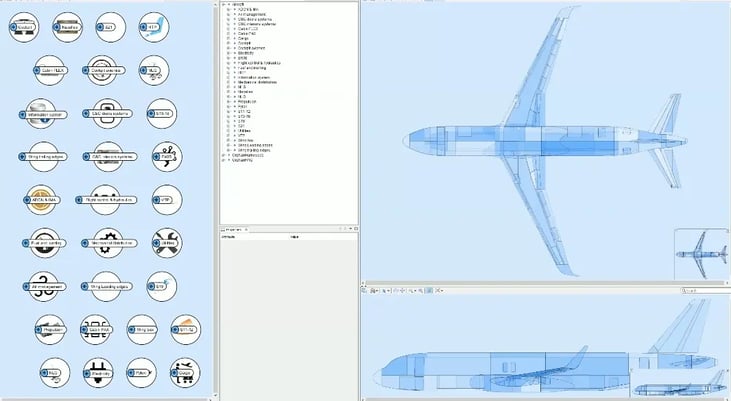
This engineering tool shows integration between CAD-based data about the architecture of an airplane, and the other system engineering artifacts and processes involved in manufacturing the aircraft.
Abstracting CAD Geometry into System Representations
Effective CAD data integration begins with the separation of geometric detail from the broader system representation. Geometry is abstracted into representations that remain stable, interpretable, and resilient as designs change.
This abstraction layer serves a critical purpose. CAD environments evolve rapidly, and models are refined, reorganized, and restructured as the design matures. When system understanding is tied too closely to those authoring artifacts, it becomes fragile and difficult to preserve as geometry changes. Abstracted system representations retain the aspects of CAD data needed for reasoning, including structural relationships, interfaces, and constraints, while preserving continuity across change.
Within this model-driven framework, CAD data informs the system representation by providing specific attributes and engineering detail. The system representation, in turn, provides continuity across versions, tools, and lifecycle phases. This separation allows integration to scale under conditions of ongoing design churn while preserving system meaning across change. It also supports continued use of domain-specific authoring and analysis tools within their appropriate roles.
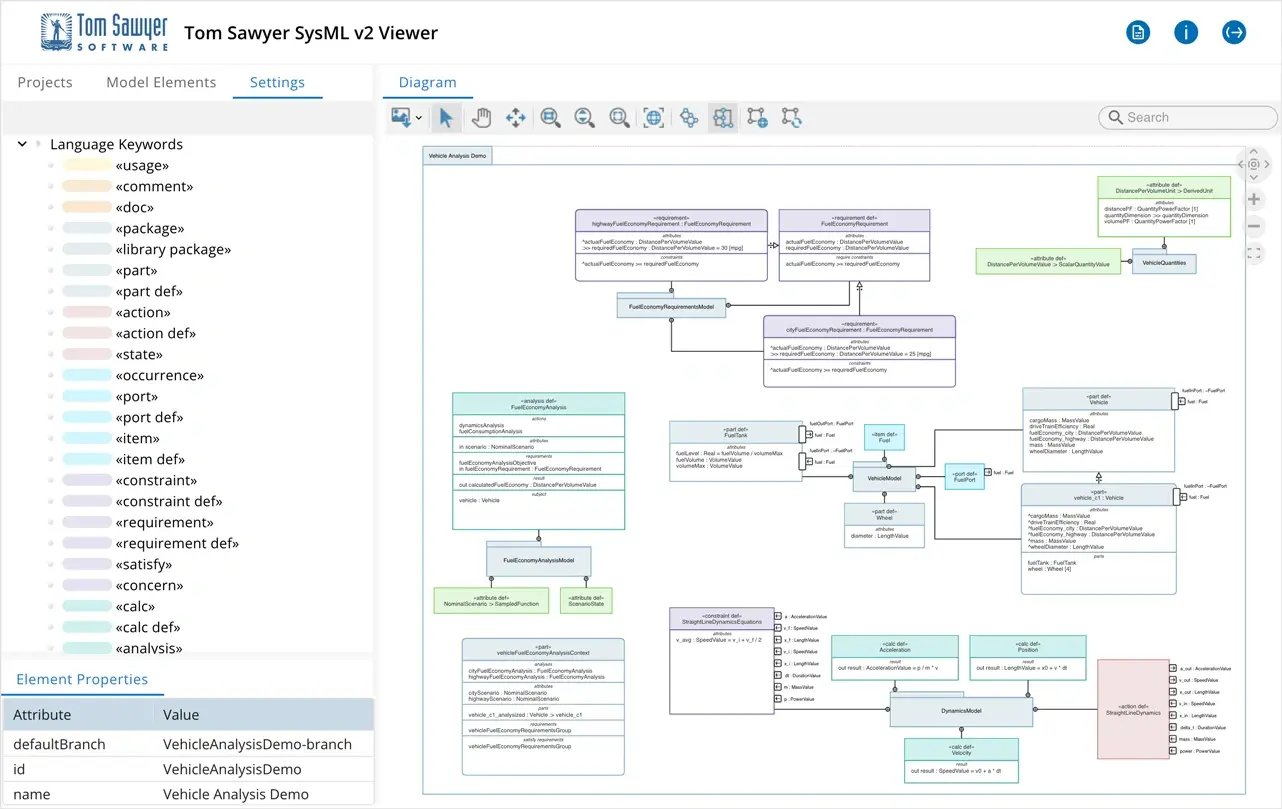
Example engineering project rendered in Tom Sawyer SysML v2 Viewer showing color coding based on language keywords, which could include CAD-derived details.
Where systems engineering models are maintained in SysML v2-compliant repositories, this abstraction layer can incorporate formal system structure alongside CAD-derived information. Tom Sawyer SysML v2 Viewer connects directly to any SysML v2 API-compliant repository and generates interactive graph visualizations of the underlying model, allowing engineers to navigate structural hierarchies, part interconnections, and behavioral dependencies without manually constructing or maintaining diagrams. When combined with CAD-derived data federated through Tom Sawyer Perspectives, this approach brings physical geometry artifacts and system structure into a shared representation, allowing each to inform the other within a coherent system view.
Maintaining Relationships, Not Just Geometry
Effective CAD data integration depends on preserving relationships across the system. Geometry describes the physical embodiment, while relationships show how physical and logical elements interact, depend on one another, and contribute to system behavior. In many traditional approaches, those relationships remain implicit or are dispersed across documentation and informal knowledge.
A model-driven integration captures parts, hierarchies, interfaces, and dependencies as explicit system elements. This makes the system easier to reason about as a connected whole. Engineers can understand how changes propagate, how components participate in larger assemblies, and how physical structure aligns with architectural intent and logical controls.
When these relationships are represented as a connected graph-based structure, engineers can explore, analyze, and visualize system dependencies directly. In practice, this enables the application of graph analysis capabilities such as shortest paths, centrality, clustering, and connectivity, revealing structural properties and dependency concentrations that are difficult to detect in file-based or geometry-centered approaches. Tom Sawyer Perspectives provides this analytical capability natively, allowing engineers to move from navigation into deeper system analysis by identifying components involved in multiple system functions, locating concentrated areas of dependency risk, and understanding how modifications are likely to propagate before implementation.
When relationships are preserved independently of geometric detail, the integrated system becomes more intelligible and easier to work with over time. Visualizations of both physical and logical elements remain valuable as part of that process, while system understanding is supported through querying, analysis, and structured exploration of modeled relationships and behavior.
This approach allows CAD data to support sustained system reasoning in advanced digital engineering environments.
CAD Data Integration in Practice: Proof of Concept Overview
Tom Sawyer Software offers a structured proof-of-concept engagement that translates the integration principles described in this article into a working application built on the client’s own engineering data. The proof of concept uses real or representatively obfuscated data from the client’s environment to surface system relationships that remain difficult to access through file-based or visualization-only approaches.
Problem Addressed by the Proof of Concept
The proof of concept addresses a common and structurally limiting condition in large engineering programs: CAD data exists across multiple sources, disciplines, and authoring environments, yet it does not operate as a unified system representation. Geometry is available, often in significant detail, but remains fragmented across tools and organizational boundaries.
Under these conditions, engineers can inspect individual models without gaining a reliable understanding of how design elements relate to system architecture or how changes propagate beyond their immediate scope. System-level questions, including the impact of design modifications, alignment with architectural intent, and consistency across lifecycle stages, often require manual interpretation and substantial rework.
The underlying issue is representational. The proof of concept addresses it by enabling CAD-derived information to participate in system reasoning through a connected representation. In engagements where clients maintain systems engineering models alongside CAD data, this can include linking geometric structure to SysML v2-defined system architecture, so physical and logical representations can be navigated within a shared graph-based view.
Scope and Boundaries of the Proof of Concept
The scope of the proof of concept is deliberately constrained. It focuses on integrating CAD-derived structural information into a system representation, built and deployed using Tom Sawyer Perspectives, that preserves meaning, relationships, and continuity across change. Existing domain-specific environments such as Teamcenter, Windchill, CATIA, and related tools remain authoritative for their respective functions, while the proof of concept operates as an integration and reasoning layer above them.
The engagement follows a structured three-phase process. During discovery, Tom Sawyer Software works with the client to define the use case, understand the relevant data sources, and identify the system-level questions the proof of concept should answer. During development, a custom graph application is built on the Perspectives platform, linking CAD-derived data to system-level constructs and enabling graph-based navigation and analysis. Typically delivered within three weeks, the result is a working web application that demonstrates relationship-centric integration using data from the client’s engineering environment. This exercise provides a clear way to communicate benefits, while outlining the scope of work required for a fully functioning solution.
The proof of concept also has clear boundaries. Detailed geometry editing, discipline-specific validation, and downstream production tooling are intentionally excluded. These boundaries keep the proof of concept engagement focused on system integration and reasoning.
What the Proof of Concept Demonstrates
The proof of concept demonstrates that CAD data can be integrated into a system representation while preserving both structural and semantic relationships. CAD-derived elements are represented within a connected system model built on Tom Sawyer Perspectives’ in-memory graph, providing a foundation for interpretation and analysis.
Engineers can use this representation to move from visual inspection into deeper system understanding. Relationships among components, assemblies, and higher-level system constructs become explicit and navigable. Graph analysis algorithms, including shortest-path, centrality, and clustering, can be applied directly to the integrated representation, revealing dependency structures and change-propagation pathways that would otherwise require manual tracing across disconnected tools. Design changes can then be evaluated for system impact before downstream consequences materialize.
This approach has been applied across engineering programs in aerospace, defense, and other domains where systems must remain coherent across extended lifecycles and organizational boundaries. Organizations including GE, Northrop Grumman, General Dynamics, NASA, and SAIC use Tom Sawyer Software to help development teams work more effectively across the digital tools and disciplines that shape their engineering environments.
Most importantly, the proof of concept shows that model-driven, relationship-centric integration of CAD data can be achieved at scale in operational settings. The integrated system remains intelligible as designs evolve, providing a durable foundation for analysis, traceability, and system-level reasoning without repeated retranslation of CAD artifacts. The new solution does not replace the existing CAD development cycle, but improves the access to and integration of the information encoded in CAD to inform the wider scope of system engineering.
Engineering and Business Value of Integrated CAD Data
The primary value of integrated CAD data lies in reducing uncertainty in system-level decision-making. By explicitly exposing dependencies and intent, organizations can evaluate the impact of change before downstream consequences materialize.
Faster System-Level Decisions
When CAD data is integrated into a coherent system representation, decision speed improves because uncertainty is reduced. Engineers can evaluate design changes within an explicit system representation that reveals dependencies, constraints, and architectural relationships, giving them a clearer basis for understanding system implications.
This shift supports evidence-based analysis grounded in a shared understanding of how physical structures participate in the system. Because that shared representation is maintained in an in-memory graph that federates data at runtime from existing tools and repositories, it reflects the current state of the design and remains aligned with ongoing change. Stakeholders across mechanical, electrical, software, and operational domains can work from the same underlying representation while continuing to use discipline-appropriate authoring environments.
The result is faster decision-making with stronger defensibility, repeatability, and resilience to change. In practice, the primary benefit lies in reducing irreversible decisions made with an incomplete understanding of the system.
Reduced Rework and Change Risk
Rework in complex engineering programs is rarely caused by incorrect geometry. More often, it results from the late discovery of system-level consequences. When CAD data remains disconnected from architectural intent and system dependencies, changes propagate silently until conflicts emerge downstream.
Integrated CAD data enables these consequences to surface earlier. Design modifications can be evaluated with respect to system behavior, interface contracts, and lifecycle constraints prior to implementation. In a graph-based integration environment, this evaluation is supported directly by upstream and downstream traversal—tracing from a modified component through its dependency graph to identify which system functions, interfaces, and lifecycle stages are affected before the change is committed. This capability replaces post-hoc conflict resolution with pre-implementation impact assessment, shifting organizations from reactive correction to proactive evaluation and reducing cascading changes and late-stage rework.
For long-running programs, this capability is critical. As systems evolve, the cost of change increases, and the ability to understand impact early becomes a primary determinant of program stability and predictability. Across engineering programs in aerospace and defense, the most expensive rework often originates not from isolated design errors, but from system-level consequences that were not visible when earlier decisions were made.
These challenges in long-running programs do not end when the product has been delivered. Increasingly, after-market software and data solutions are integral to the business proposition of the delivered system. The accessibility of system information that is ready to inform these value-added tools is critical to providing scalable and maintainable solutions for the entire lifecycle of the engineered product. This is as true for an aircraft or a building, as it is for a personal computer or cellular phone.
Foundation for Scalable Digital Engineering
Integrated CAD data forms a structural foundation for advanced digital engineering capabilities. A digital thread cannot be sustained if physical design information remains fragmented or semantically opaque. Likewise, digital twins cannot remain aligned with operational reality if geometry is disconnected from system state and intent.
By anchoring CAD-derived information within a persistent system representation, integration enables continuity across extended lifecycles. Systems that evolve over decades, through upgrades, modifications, and operational changes, require representations that outlast individual design phases and tool generations. Tom Sawyer Perspectives provides this foundation through its in-memory graph architecture, which federates data from existing engineering tools at runtime and allows the system representation to evolve alongside the design without requiring re-import or manual realignment. Where operational continuity requires real-time visibility into the integration layer itself, tracking how data flows between assets, services, and transformation pipelines as the system operates, Tom Sawyer Data Streams extends this capability into live environments by rendering a dynamic graph that updates as telemetry arrives and integration behavior changes.
CAD data integration serves as an enabling condition for scalable digital engineering across long-lifecycle systems that must maintain coherence, traceability, and adaptability over time. Organizations that establish this representational foundation early gain a compounding advantage: as systems grow in complexity and programs extend across decades, system understanding can be maintained through the graph structure itself, even as the surrounding tools, files, and disciplines continue to expand.
When CAD Data Integration Becomes a Strategic Capability
CAD data integration becomes a strategic capability when it functions as a structural enabler of system governance across the engineering lifecycle. At this level of maturity, success is measured by the organization’s ability to sustain a coherent understanding of the system as complexity and change increase.
This shift takes hold when CAD-derived information is embedded in a persistent system representation that spans projects, tools, and design iterations. Decisions are grounded in an evolving system representation that preserves intent, relationships, and rationale over time. As a result, engineering organizations can reason about their systems continuously as change occurs.
Strategic CAD data integration also reshapes the connection between engineering execution and decision-making. System-level insight becomes available earlier and remains accessible for longer, reducing reliance on ad hoc expertise and manual reconciliation. This capability is especially important in environments where systems must be adapted, extended, or modernized across long operational lifecycles. Without it, system governance becomes increasingly dependent on periodic reconstruction of understanding.
At enterprise scale, the key differentiator is the durability of system understanding. When CAD data integration supports that durability, it becomes a strategic asset that underpins scalable digital engineering and long-term system resilience. Tom Sawyer Software’s graph-based approach aligns naturally with this need by helping organizations keep complex engineering systems observable, navigable, and analyzable over time.
Final Thoughts
CAD data integration reaches its full value only when it moves beyond a technical synchronization concern and functions as a mechanism for preserving system understanding. In advanced digital engineering environments, the central challenge is not moving design data, but sustaining meaning as systems evolve across tools, teams, and lifecycle phases.
By abstracting CAD-derived information into connected system representations, organizations can reason about structure, intent, and change without anchoring understanding to volatile design artifacts. This approach enables continuity across evolving engineering environments and supports analysis grounded in connected system representations.
In this sense, CAD data integration functions as part of a broader engineering capability that supports scalable digital engineering over time. It is a prerequisite for scalable digital engineering, supporting long-lifecycle systems, cross-disciplinary decision-making, and continuous system coherence. Organizations that continue to treat CAD data integration as a data-movement problem will increasingly find themselves managing detail without sustaining system understanding.
About the Author
Caroline Scharf, VP of Operations at Tom Sawyer Software, has 15 years of experience with Tom Sawyer Software in the graph visualization and analysis space, and more than 25 years leadership experience at large and small software companies. She has a passion for process and policy in streamlining operations, a solution-oriented approach to problem solving, and is a strong advocate of continuous evaluation and improvement.
AI Disclosure: This article was generated with the assistance of artificial intelligence and has been reviewed and fact-checked by Caroline Scharf and Liana Kiff.
FAQ
What is CAD data integration in digital engineering?
CAD data integration in digital engineering is the practice of connecting CAD-derived geometry and metadata to a system representation that preserves relationships, intent, and lifecycle continuity. Within that representation, engineers can reason about how physical design decisions influence system behavior, architectural structure, and the propagation of changes over time.
What do we mean by CAD metadata?
CAD metadata includes structured information that describes, identifies, or contextualizes CAD model elements, such as components, materials, and layers. CAD technology is based on the need for accurate blue prints that describe the physical parameters of anything that we build. Metadata includes information about specific manufactured devices or elements; for example, not just the location and length of a pipe, but what is expected to flow through it. This metadata also may include information about the wiring of sensors, and how those sensors should be identified within the control system. However, the fundamental basis of CAD is rooted in the description of the physical aspects of these things, such as the location and length of a beam or wire, rather than the logical aspects of the system they comprise.
Where does CAD data integration typically fail, even in mature PLM environments?
Even in mature PLM environments, CAD data integration often breaks down when teams need to answer system-level questions. PLM systems can manage configurations and change processes effectively, but they do not usually provide a representation that connects CAD-derived structures to system behavior, architectural intent, or cross-domain dependencies. The result is strong artifact control without an equivalent level of system understanding. This risk can be mitigated by thoughtful consideration of how semantic meaning will be established and managed across the different layers of the system.
What distinguishes system representation from system visualization in CAD integration?
System visualization focuses on rendering geometry or assemblies in a visually coherent way. System representation encodes relationships, dependencies, intent, and lifecycle meaning in a form that supports reasoning. A system can appear visually complete yet remain representationally incomplete if it cannot answer questions about impact, traceability, or architectural alignment.
Further, CAD is most commonly used to represent the actual physical design and connection between components, in aid to correctly manufacturing and assembling the physical embodiment of the system. A CAD-based representation is not the most suitable way to visualize system information for other use cases. In a real-world scenario, systems that are physically distant from each other may have very tightly connected relationships, such as the Air Handling Unit on the rooftop, and the hot water boiler in the basement of the facility. Visualizing these together may be necessary, but not well aided by a visualization that is spatially accurate.
How does this approach handle design churn without constant reintegration?
Model-driven CAD data integration handles design churn by separating volatile geometric detail from stable system constructs. Geometric changes are captured through linked attributes and relationships within the system representation, preserving structural continuity as designs evolve. This keeps the representation coherent over time and limits the need for repeated re-imports or continual realignment across connected tools.
What types of system questions become answerable once CAD data is integrated at the representation level?
Once CAD-derived information is embedded in a system representation, engineers can ask questions that are difficult to answer reliably in file-based environments. These include how structural changes affect architectural responsibilities, which components participate in multiple system functions, where dependencies concentrate risk, and how modifications propagate across lifecycle stages. The value comes from analytical access to relationships, not just visual access to geometry.
How does this integration model support cross-disciplinary collaboration without forcing tool convergence?
This integration model supports cross-disciplinary collaboration by establishing a shared system representation while allowing each discipline to continue working within its specialized tools. CAD-derived information can be interpreted consistently across domains, giving mechanical, electrical, software, and operational stakeholders a common foundation for understanding the system, even when their daily work remains distributed across different environments.
Why are graph-based representations particularly suited to CAD data integration at scale?
Graph-based representations make relationships explicit, navigable, and analytically accessible as systems grow in complexity. Dependencies, hierarchies, and interfaces become part of the system structure itself, enabling engineers to apply algorithms such as centrality, clustering, shortest-path, and connectivity to reveal structural patterns that would otherwise require significant manual effort to reconstruct. This principle is reflected in Tom Sawyer Perspectives, whose in-memory graph model allows engineering teams to move from inspecting CAD-derived system representations to analyzing them at scale.
What limitations remain even with model-driven CAD data integration?
Model-driven integration does not eliminate the need for domain expertise or replace detailed engineering analysis within CAD or simulation environments. Its role is to preserve system meaning and coherence across the lifecycle while supporting broader system reasoning. Respecting those boundaries helps keep the integration layer stable and useful as surrounding engineering environments continue to evolve.
When does investing in advanced CAD data integration provide diminishing returns?
Diminishing returns are most likely in systems with short lifecycles, limited cross-disciplinary interaction, or infrequent change. Long-lifecycle systems with high coupling, frequent modification, and regulatory or operational complexity usually benefit much more from advanced integration. The strategic value of integration is driven more by system longevity and interdependence than by model fidelity alone.
Submit a Comment